The new year is coming, so our gift to you is the five fairy tales we will explore in the 2025-2026 financial year.
We start off in July with our Grimms story, Hans My Hedgehog; perhaps known from the initial episode of Jim Henson’s beautiful 1980s TV series, The Storyteller.
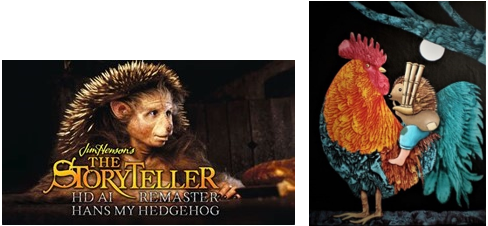
As a consequence, it might be one of the better-known Animal Bridegroom stories, (a most popular sub-group of fairy tales), along with Frog Prince, Beauty and the Beast, Snow White and Rose Red, and many enchanted snake stories; all of them originating with the Psyche and Eros myth.
These stories place the male lead as the one who needs rescuing, so they are popular sources for re-tellings with a Strong Woman as heroine. When a woman is the questor, yes she is strong, she is the hero, the rescuer – but with a lot more suffering, and a reward of getting her man to take her back.
We’ll also examine that the end doesn’t match the beginning, the disenchantment doesn’t resolve the enchantment we’re told of. There’s a missing piece that would make sense of the story’s logic, but what is it?
The September stories are from two European nations well-known for their fairy tales, and both feature a Magic Flight.

Firstly, we have The Master Maid (i.e. the best maid of all) from Norway. Norwegian stories, generally, achieved significance due to the high quality of the collection (Norwegian Folktales) created by Peter Christen Asbjoernsen and Jorgen Moe in 1841 – although most of the stories in that collection are animal stories (e.g. The Three Billy Goats Gruff) or folktales, with no magic.
In 2019, we had the joy of looking at the unjustly obscure Tatterhood (pls read if you haven’t done so!). It’s interesting that Master Maid, like Tatterhood, also features a bold young heroine, who does the rescuing, though the question does arise as to why she didn’t escape herself before the rather lacklustre hero arrived. Is this sort of tough female representation particularly Norwegian or Scandinavian, or were all European fairy tales this varied before the Grimms started editing their source material?
However, Master Maid‘s key feature is the common (or not so common) fairy tale trope of the Magic Flight, which have the fleeing hero or couple throw down a series of previously-gifted talismans, which transform into incredible obstacles to delay or vanquish the pursuing villain. Jason and Medea may have been the first to participate in this.
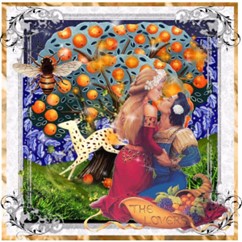
Another example of the Magic Flight comes from a nation that’s produced many fairy tales: France. The Bee and the Orange Tree was written by Marie-Catherine D’Aulnoy in the 1697 book that first coined the term ‘fairy tale’, giving rise to the whole genre.
The Bee and the Orange Tree is also the name of an online journal. Whereas d’Aulnoy featured in the AFTS web series, Salonline, where she was portrayed by our own Eliane Morel, or more factually in the Salonline book of essays and stories we wrote about the Salons.
For November, our Australian fairy tale (usually a difficult choice) is the 21st century original story, ‘The Sixteenth Brolga‘ created by Holly Ringland specifically for the Queensland Gallery of Modern Art (QAGOMA) exhibition, Fairy Tale. The exhibition catalogue, Fairy Tales in Art and Film, contains the tale, beautifully illustrated with the Australian pre-Raphaelite painting that inspired it – Spirit of the Plains by Sydney Long, 1897. (Or read it via Holly’s sub-stack.)
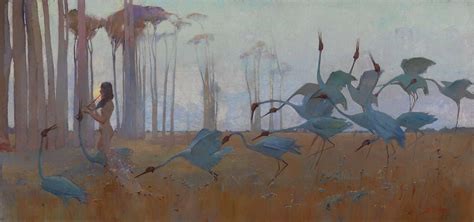
The Sixteenth Brolga is brief and subtle; full of brush strokes of meaning. The only action really is two different people looking at this painting, seeing what it is, and what might be – a picture of time and transformation from a contemporary urban, Australian perspective.
As Ringland’s The Seven Skins of Esther Wilding interweaves seven fairy tales about selkies, swans and women, we can use The Sixteenth Brolga as her model for how to write an original Australian fairy tale, as well as how to sample fairy tales within a broader narrative.
Right in time for the 2026 Lunar Festival in February, we will investigate two Vietnamese fairy tales. Surprising, considering how many Australians have Vietnamese heritage, that it has taken us this long to explore any Vietnamese fairy tales, or tales that fulfil this function, even though they weren’t created in that form, but instead combine indigenous myths and introduced stories from colonisers from different eras.

The Moon Boy may be of interest to Westerners, as it combines the moon’s usual feminine associations with a masculine hero – although in many versions, Cuoi really isn’t a particularly heroic hero.
The Mosquito, which could be labelled a pourquoi story or legend has some intriguing and potentially misogynstic connections with the Chinese story of Lady White Snake, as explored in 2024.
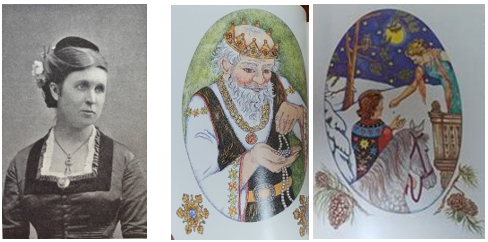
For April 2026, we focus on The Queen’s Necklace, an original 1890s fairy tale written by Helena Nyblom (1843-1926), who achieved fame as a fairy tale writer in the generation following Hans Christian Andersen. The Danish-born writer, who moved to Sweden, was actually more interested in her poetry, music, and six children.
The story is largely about greed, and could be compared to Oscar Wilde’s Happy Prince, (which we investigated in 2021), that was written not long after. An American revision by Jane Langton in 1994 tidied up some loose ends, particularly in creating a satisfying love story and giving the villain a meaningful death.
Literary fairy tales can form an interesting contrast to what might be thought of as folk (i.e. authorless or of unknown authorship) stories, with a much more conscious choice of language and treatment of psychological and social issues, while still maintaining the essential magical elements.
 Australian Fairy Tale Society