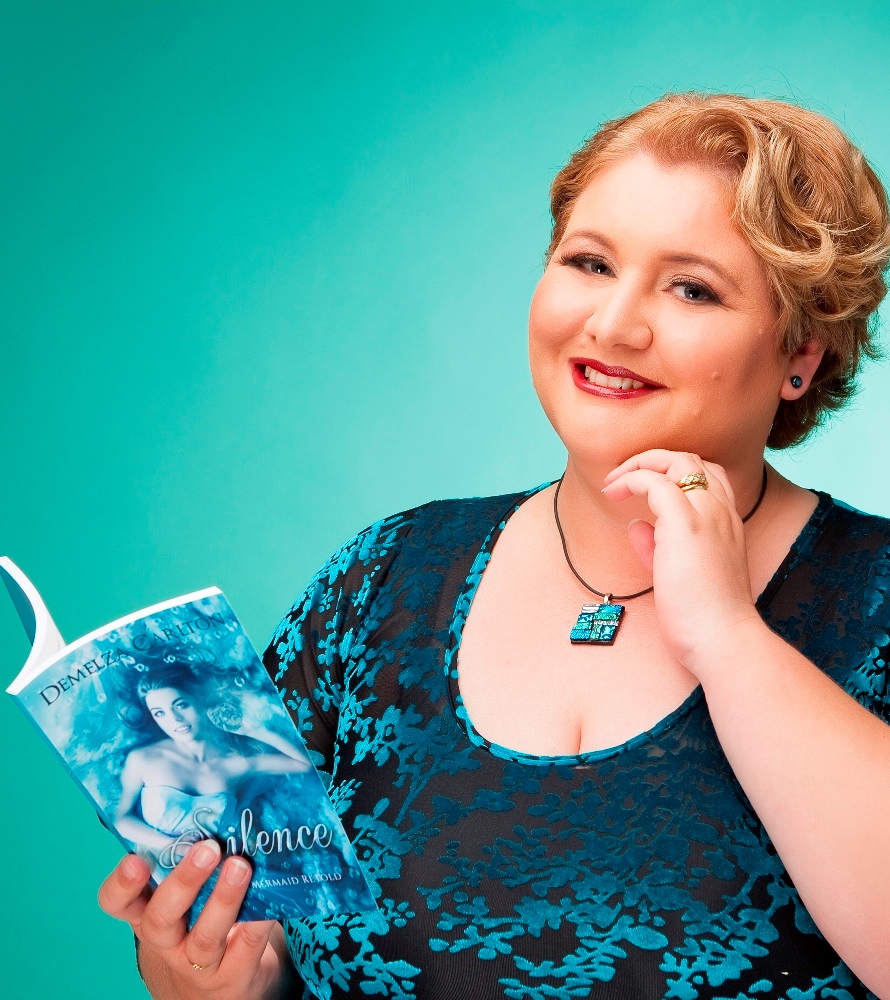
Demelza Carlton – our 2025 keynote!

You’ve always loved the ocean, but on your first snorkelling trip you found you were afraid of fish. How did you overcome that?

Lots more snorkelling, a bit of scuba diving, and swimming with sharks, actually. It’s hard to be afraid of fish when you’re chasing a shark for a photo you promised your kid, and it’s swimming away as fast as it can. I’ve now swum with sea lions, sharks and sea cucumbers, and stood on spray-drenched cliffs over a seeting sea as a seven-metre cyclonic swell surged in, shattering a shipwreck below. And I live in Perth, WA, the shark attack capital of the world – and can assure you that sharks taste delicious!

While doing your Masters research on shipwrecks at remote islands off the WA coast, you came across one that didn’t make sense. How did that inspire a multi-book series about mermaids?

During a cyclone in the 1920s, a fishing boat broke free of its moorings with the two-man crew still aboard. One man managed to swim ashore, but the other couldn’t swim, so he disappeared in the waves when the boat sank. Everyone thought he drowned, but his body wasn’t found… until more than three weeks’ later, when it washed up miles from the boat went down, in the complete opposite direction to the ocean currents. Stranger still, the man was recognisable – which meant his corpse hadn’t been floating at sea for all those weeks – and he’d done some first aid to his broken leg. There was nowhere the man could have been all that time except in the ocean; because if he’d washed up on the island, someone would have seen him and helped him. So how could a man survive for three weeks at sea, do first aid on himself, and yet drown within sight of land?

I was amazed to find heaps of mermaid stories from all over the Indian Ocean, and of course I also dug out my copy of Hans Christian Andersen’s tales to read the fairy tale I remembered. Put the two together with my miracle man, and I had a story.

What if the reason mermaids went ashore was a biological imperative – they needed human men in order to breed – but instead of saving the man like the prince in Andersen’s tale, my Indian Ocean mermaid accidentally lost him to the waves? She’d be heartbroken, not wanting to return to the place she lost the man for a very long time. And a very long time later, she did come ashore again at the same islands to investigate an environmental issue. Right at the same time, a brand-new deckhand starts work on a lobster fishing vessel at the islands; a deckhand, who’s very interested in the woman who lives in the fishing shack next door to his. And he just happens to have the same first name as the man she lost to the waves…

What drew you to shipwrecks off the WA coast as your area of research?

It wasn’t just shipwrecks – my Masters is in Emergency Management, and my research project involved plane crashes, wartime battles, quarantines and tsunamis, as well as shipwrecks. I have a personal connection to the Batavia disaster at the Houtman Abrolhos Islands, up near Geraldton as one of my ancestors was the navigator. That might explain why I get lost so easily!

[In June 1629, Dutch-owned ship Batavia struck a reef and sank amongst islands 65km off the coast of what is now Western Australia. The whole story is chilling, if you want to read about it.]

What had you planned to do with that qualification, before becoming a writer?

I was investigating those incidents for my job as an administrator at a remote site, to improve our emergency management planning. Seeing as I was doing the research anyway, turning it into a Masters research project and getting the qualification seemed like a no-brainer.
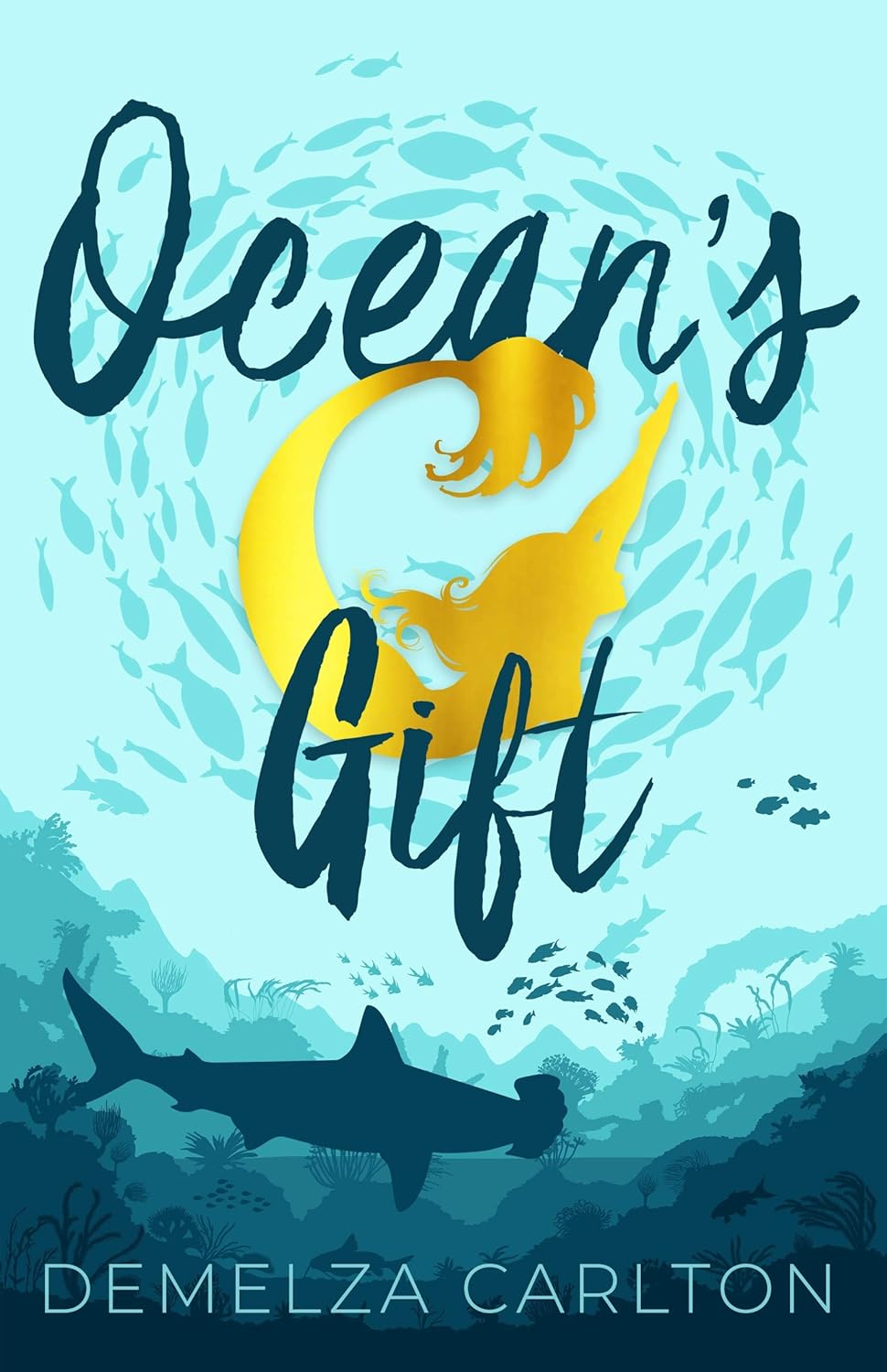
That research inspired your first book, Ocean’s Gift, about a mermaid off the WA coast, which turned into a three-book Siren of Secrets trilogy and the six-book Siren of War series. What made you want to set a fairy tale story in Australia, rather than the traditional European setting?

At the time, I’d lived most of my life here, and my research showed that mermaid legends were everywhere – especially in the Indian Ocean. This part of the world is kind of a fairy tale to most of the rest of the world, so instead of imagining somewhere new that I’d never seen, I wanted to breathe new life into old legends in a place I knew well, which many of my overseas (and east coast Australian!) readers probably don’t.

Why do you think so many Australian writers stick with more traditional settings?

I think they do it because that’s what publishers want, and know how to sell. It’s also closer to their source material, which is usually Hans Christian Andersen and the Brothers Grimm, and to what Disney do with their fairy tales – and let’s face it, Disney definitely knows how to sell fairy tales!

It’s a very personal choice – why set any book anywhere? Writers are told to write what they know. Well, I’m Australian, not English, so I can’t wax lyrical about the beauties of an English wood, because I’ve never seen one. I have gotten my feet wet in both the Baltic and the North Sea though, and seen some of the less populated parts of France and Eastern Europe, so when I chose to write my mediaeval fairy tales, those are the places I tended to set those stories. The history in those regions is particularly fascinating, and also little-known in the English-speaking world.

You also include environmental issues. How important, for you, is it to incorporate these?

I absolutely do! I admit those mostly come up in my contemporary and sci-fi stories, more than my mediaeval ones, but while I was visiting relatives in the Netherlands, they showed me a small desert in Hoge Veluwe National Park that resembles the Pinnacles in WA’s Nambung National Park.

I did some digging, and it turned out that around a thousand years ago, this particular region was the only arable land in a sea of marshland – until a combination of flooding and salt production resulted in salinity issues that turned it into desert.

What are you looking forward to about the Australian Fairy Tale conference?

I miss academic life, and while I get to do a lot of research for my books, most of it is on history, geography, and the cutting-edge of science for my sci-fi, rather than in-depth research into origins and interpretations of fairy tales. I’m really hoping to get my geek on and listen to other people’s findings on fairy tales, instead of constantly having to think of how a modern audience would relate to them.

Next month, find out more about Demelza’s fairy tale books, her favourite (and least favourite) tales, and some of her research trips around the world. Learn even more by visiting her online at www.demelzacarlton.com. Enjoy Part 2!
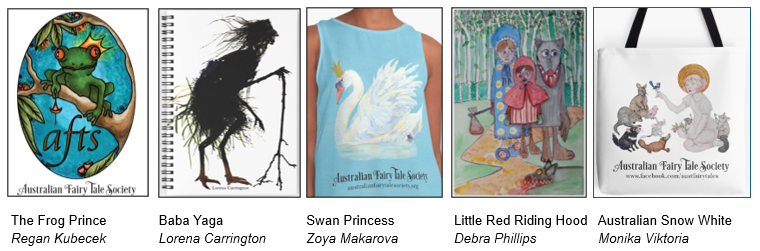
Fairy Tale merchandise for sale

The artist members of the AFTS contribute so much beauty and insight to our understanding of what fairy tales are and what they can be – and you can own some of this remarkable work yourself through our online Redbubble store. https://www.redbubble.com/people/austfairytales/shop

Here you will find unique Australian artworks that you can match to the object of your choice, like clothing, mugs, soft furnishings, etc.

From fairy tale art

To our conference art

And the logos of the Fairy Tale Rings that members love to wear, especially to Rings, conferences, book and art events)

We love this way of celebrating our member artists and giving the world an opportunity to see their work, as well as surreptitiously letting the world know about the AFTS too! We are enormously grateful to them for their generosity in sharing their talents with us.

Buying any of the AFTS merch is a wonderful gift to yourself, a way of identifying yourself as a person with an individual and magical view of the world, and maybe opening up some conversations.

And this time of year, when you might be looking for gifts that have some meaning, that are not generic and mass-produced, is an ideal time for giving something special.

You’d better dive in quickly so that all you want is delivered in time for Christmas – though it’s always the right time to give AFTS merch.

Happy shopping!

Call for Presentations!

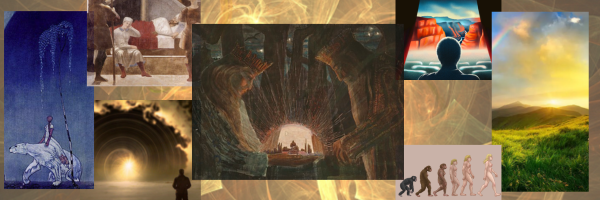
A composite of images start on the left with a person with long hair in a long white dress riding a polar bear under a tree with frosted leaves; men in ancient clothes by the bedside of a dying king; a man approaching a tunnel with bright light at the end; one crowned man offering another crowned man a precious glass bottle while figures stand in the background; a man in a theatre watching volcanic lava flows on a screen; the classic image of a chimpanzee on all fours following an ape on two legs following increasingly more human figures, but different in that the humans are female; finishing with a rainbow and golden clouds over a grassy countryside devoid of people or buildings.

Once and Future Tales: What was, what is, … What if?
Australian Fairy Tale Society Conference 2024

Call for Presentations – Submissions now open here
EXTENSION – Submissions now close at midnight AEST on March 8th!
SUBMISSIONS HAVE NOW CLOSED

The Otherworld… Everywhen… Standing in the story-space…

“Once upon a time” takes us into a place where time moves differently.

Fairy tales allow us to time travel to the past and scry into the future, uncovering lessons from what once was and paving the way for what might be. We can create conversations with our ancestors, premonitions for our descendants, and dreams of our here and now. Like King Arthur and Finn Macool, what tales lie waiting for our clarion call? And which, like Briar Rose, must be put to sleep for a spell?

Through folk and fairy tales we stitch together motif and memory, epics and anecdotes creating letters from the past to the future. But how do we hold these tales in our hearts here and now?

Do we tell stories because they have happened or because, maybe, they are yet to be?

“Time comes into it.
  Say it.             Say it.
The universe is made of stories
not of atoms.”
from The Speed of Darkness by Muriel Rukeyser

We invite you to submit proposals for what you could present at our 10th annual conference, drawing from the creative invitation above. We encourage a variety of forms and ideas. Please submit your proposal on our online form here by midnight 8th March 2024 (extended from the initial date). Submissions are now closed.

The 2024 conference will be primarily held face-to-face, with some hybrid/online sessions.

As always our focus is on the Australian interpretation and confections to fairy tales, particularly contemporary diverse Australia. As AFTS Conference-goers delight in diversity, we are looking for –

  • Talks of no more than 25 minutes, with the option of 5 minutes Q&A
    • These could be case studies of projects with a fairy tale basis
    • Analysis of a particular tale or tale type
    • Histories, research, and more! Be creative!
  • Panel discussions of no more than 25 minutes, with the option of 5 minutes Q&A
  • Performances of no more than 10 minutes, with an option for 5 minutes’ Q&A
  • Displays of your books, art, puppets, toys, costumes, etc for sale, or to decorate our venue.
  • Stalls to sell your merchandise

All submissions will be responded to in early April, so that the full program can be announced mid-to-late-April.

The Australian Fairy Tale Society was established to investigate, create, and communicate fairy tales from an Australian perspective.  Local Rings gather five times a year, and our Magic Mirrors gather by Zoom almost every month, to explore specific fairy tales like a book club for fairy tales.

Some previous conference themes include The Fairy Tale in Australia, Transformations, Into the Bush, Gardens of Good and Evil, Magic Mirrors: The Seen and the Unseen, and Fairy Tales: Flesh or Fossil. We have an irregular Ezine and have published an original Anthology, South of the Sun: Australian Fairy Tales for the 21st Century. 

Queer Fairy Tales: Part 1

Do gay fairy tales exist? How about bisexual fairy tales? Trans fairy tales? Asexual fairy tales? If you did a survey of the most well-known fairy tales you’d answer no. But that doesn’t mean they don’t exist. My name is Em Chandler (she/they), I’m currently the Vice-President of the AFTS, and I adore the odd, dusty, and overlooked; especially when it comes to fairy tales. And I’m here to tell you queer fairy tales do exist.

“But if queer fairy tales exist, where are they? What are they?”, I hear you ask…

Well, that is another story for another day. And I promise I will tell it to you. Just wait until June.

For as long as there have been stories, storytellers have been reimagining and interpreting those same stories. That includes queer storytellers. As here in Victoria (my home state) it is soon to be Midsumma Festival – our annual LQBTQIA+ festival, let’s have a look at a fraction of the retellings made so far.

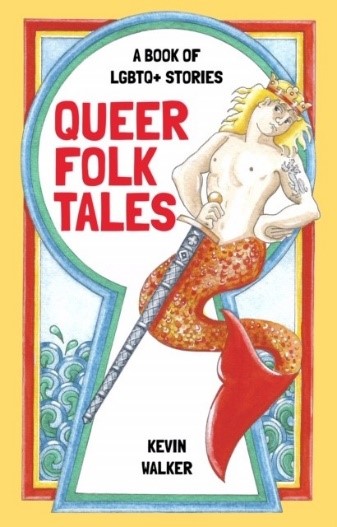
A book cover featuring a muscled merman with an orange tail carrying a sword, entitled Queer Folk Tales: A book of LGBTQ+ Stories by Kevin Walker.

English storyteller and author, Kevin Walker (he/him), has a delightful volume called Queer Folk Tales. Drawing from his own repertoire of stories, he adapts and reimagines queer folk tales, fairy tales, legends and myths. I love revisiting The Blue Rose in this collection. It’s a beautiful story about love and truly seeing someone, so I’m surprised this is the first queer version I have come across! If you know of others, let me know. (Though despite popular belief, the original is not Chinese but a 19th century literary fairy tale. But it’s been shared so much as a ‘folktale’ I wonder whether that really matters now…).

Book cover showing vines of yellow roses around an oval image of a winding river leading to mountains under a cloudy sky with a crescent moon. The book is entitled Everything Under the Moon: Fairy Tales in a Queerer Light, edited by Michael Earp and Illustrated by Kit Fox.

Everything Under the Moon is absolutely beautiful anthology only published last year. And best of all, over 50% of the authors are Australian! Edited by Michael Earp (they/them)*, like Queer Folk Tales above, some stories are set in once upon a time, others modern day, some even science fiction but each is delight to behold. I was kindly sent a review copy (which I received on behalf of the AFTS). A full review should appear in our next E-Zine, but don’t wait until then – I cannot recommend it enough. The book is physically beautiful, and the tales even more so. Picking one favourite is an impossible task, but… If The Shoe Fits by Lili Wilkinson and Moonfall by Alison Evans are still dancing in my head after the most recent reread. Wonders await no matter of these magic beans you chose.

A black and white book cover with triangular cut out edges, entitled Kissing the Witch by Emma Donoghue.

Kissing the Witch: Old Tales in New Skins is a collection of thirteen interconnected tales by Emma Donoghue (she/her) exploring Cinderella, Snow White, Beauty and the Beast and more with a decidedly queer and feminist lens. I adore that a character from each proceeding story becomes the narrator of the next in this collection. Each new fairy tale adding depth and complexity to the next, and vice versa.  

Book cover showing a girl with wild black hair in a blue balldress with butterflies in her hair. The title is Cinderella is Dead by Kalynn Bayron.

But we’re not limited to short stories, there’s novels too. Cinderella is Dead by Kalynn Bayron (she/her) takes the Cinderella tale we’re most familiar and says, “what if it was true, and what would the world look like 200 years later”? Dystopian, fast paced, and a wickedly good re-examination of the tale we all know. One thing I love especially is that Bayron hasn’t set out to say the Cinderella narrative is bad – but how the narrative can be twisted and used by those in power.

The Magic Fish by Trung Le Nguyen is a semi-autobiographical graphic novel. Tiến Phong is a second generation American Vietnamese teenager, and its through fairy tales he helps his mother learn English. But he’s also struggling to tell his mum about his sexuality. So, fairy tales step in once again. It’s a stunning narrative with gorgeous illustrations, and fantastic use of colour too.

A poster for Midsumma Festival, featuring a group of five exuberant singers, entitled The Story Keepers Feb 3-4.

There’s theatre too! The Story Keepers is a play/emerging children’s theatre ensemble that retell and perform overlooked fairy tales, especially queer fairy tales. Yes, this is a shameless plug, because I’m the director and writer! Three fairy tales, none of which you will have heard of, from Iceland, Germany, and Catalan, and all funny, enchanting and queer. Perfect for everyone 5+. If you’re Victoria based, we’ve got shows on February 3rd and 4th for Midsumma. Details and tickets here: https://www.midsumma.org.au/story-keepers. And while I’m doing a shameless plugs, I’ve written my own queer retelling of Cinderella – The Midnight Princess – and its been included in a new anthology, Out-Side: Queer Words & Art from Regional Victoria (It’s being launch on February 11th https://www.facebook.com/events/1104647510583022).

***

This list is barely the start, a needle in a haystack of diverse, brilliant, wildly different approaches to rediscover, reimagine, and reclaim fairy tales for queer people. There are a thousand and one queer fairy tales to explore, and I strongly encourage that you do. If you want a helping hand delving into queer folktales shared and collected from the oral tradition, I’m happy to give it to you. In June.

Do you think you can wait??

* For more information about the editor of “Everything Under the Moon”, ‘Take me to your reader’ will be interviewing Michael Earp on 24 February 2024.