For ‘Witches in Fairy Tales: Wise Women or Evil Enchanters?‘, we invite you to submit presentations in a diversity of forms, as this is one of the delights of an AFTS conference. How will you weave a fairy tale witch – male or female, wicked or wonderful – into your presentation?
Talk of 25 minutes, including optional 5 minute Q&A
Performance, 10 minutes max, with optional 5 minute Q&A. For example, storytelling, puppetry, theatre, singing, music, dance.
Panel discussion, 30 minute maximum, including 5 minute Q&A
Workshop, 45 minute maximum including set-up time. For example, art, writing, storytelling, sand sculpture, puppetry, gardening, cake decorating
Case study (or poster display) of a creative process of staging a fairy tale performance
Games or participative activities, 10 minute maximum
Launch of your book, video game, performance
Sales and/or displays of your books, art, puppets, toys, costumes, etc.
New ideas or formats welcome!
Stuck for ideas? Here are suggestions to pursue or inspire!
Create your own original fairy tale of witches and wisdom set in Australia – as a story, song, play, poem, artwork, or other creative medium.
Examine the pagan roots of a fairy tale, before it was re-written by male tellers such as Perrault or the Brothers Grimm. Our keynote speaker Lucy Cavendish has done this in brilliant ways in her book Magickal Faerytales: An Enchanted Collection of Retold Tales.
Map the parallels between the real-life minimising of women’s power to the way it has happened in a fairy tale, such as Cinderella’s magical helper changing from wise and powerful witch to sweet and bumbling fairy godmother.
Weave together a mini-workshop to help people connect with their own fairy-tale witch archetype, or to draw a magical character, write their own tale, or perform a group ritual.
Re-imagine a supposedly powerless princess, who has an animal familiar (very witchy!) and the power to face impossible tasks, with the help and intervention of kindly creatures.
Consider how a powerful fairy-tale witch is showing up in your own life to help you heal, provide wisdom as you approach cronehood, or strength as you become a protector.
Explore the origins of Baba Yaga, often a stereotypical wicked witch in modern tales, whose roots can be traced back to old winter goddesses, and who is connected to deities of the dawn and springtime.
Chart the journey of Jack, of Beanstalk fame, as one who travels to another realm to bring back magical treasure.
Argue the case of a fairy-tale villain. What changed Sleeping Beauty’s Maleficent from one of the good fairies into an evil sorcerer? What motivated the sea witch to agree to the Little Mermaid’s request? Why could the much-maligned ogre not defend against the thief who kept stealing his magical treasures?
Or something completely different! Witches and other magical folk contain multitudes! The sky is the limit, so reach for your broom, because we want to hear from you!
The Australian Fairy Tale Society was established to investigate, create and communicate fairy tales from an Australian perspective. Local Rings and our Magic Mirror (Zoom) gather several times a year to explore specific stories, like a book club for fairy tales. We have an irregular eZine, a YouTube channel, Redbubble merchandise store and an original anthology, with another in progress.
Chat with us, ask questions, read conference blog posts (like this one!) or engage with us on Facebook and Instagram.
Lucy Cavendish, our 2026 keynote speaker, has a multitude of talents and a love of all things faery!
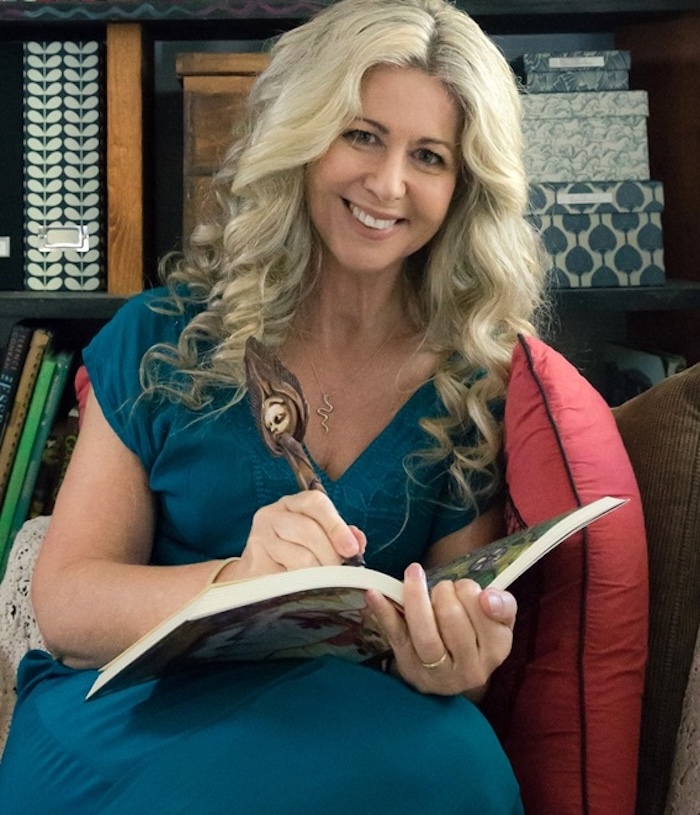
Lucy Cavendish – author, oracle deck creator, podcaster, witch, surfer and wildlife carer – will keynote our August 15-16 conference in Melbourne, Witches in Fairy Tales: Wise Women or Evil Enchanters?
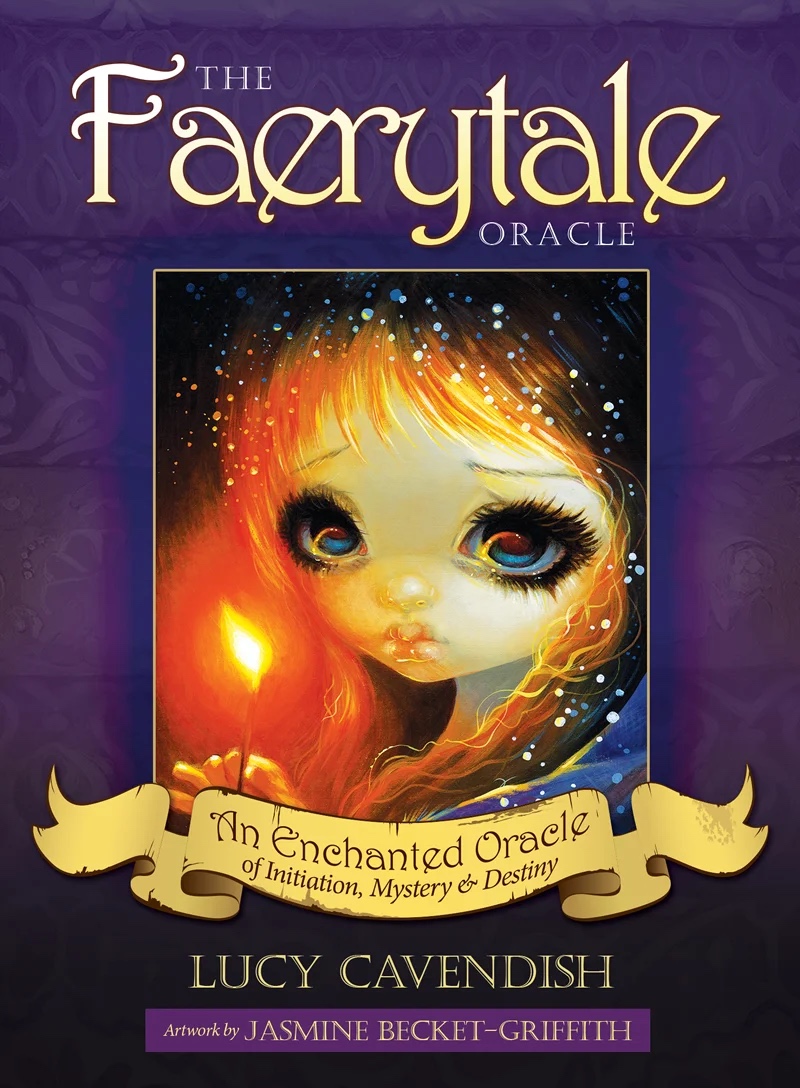
Lucy’s beautiful book Magickal Faerytales and her enchanting deck The Faerytale Oracle, along with the magic she weaves as a witch in this country, make her the perfect person to open the conference and ground us in fairy tale wisdom. In Part 1, she discusses some of her favourite stories, what connects people to them, and the magic that lies within.
What drew you to fairy tales as a child?
I can’t really recall a time before fairy tales. I recollect, faintly, being introduced to them through a mixture of being read aloud to – that was my mum mostly, doing the reading – and films. I have fragmented, delicious memories of being obsessed with the Three Good Fairies from Disney’s 1959 film Sleeping Beauty – Flora, Fauna and Merryweather. So, films were one way – the big screen, as a tiny child, was enormous and magickal and absolutely engulfed me! It made a new world come alive in such an immersive way.
I also had a little 45rpm record of the Fairy Godmother’s song from the 1950 Disney version of Cinderella, and I played it over and over, prancing about with my imaginary wand, tapping the cat’s head and imagining it being able to fly with me upon its back.
But mostly, I dragged books filled with fairy stories off the shelves I could reach, books nearly bigger than myself, and I carried these around, begging my mother to read me the stories. She has wonderful voice skills, my mum, and she did such a great job that I was completely besotted not only with the stories but her vivid changes of voice for each character! She eventually started teaching me to read very early, mostly so I could stop entreating and entrapping her with my demands for fairy tales.
What did you love most about them?
I think fairy tales connected so strongly to me as a child because they were fantastical, and so was my entire world as a child. Everything was new and unknown, so it was magickal, imaginative, and a little scary, utterly filled with wonderment. The tales were frightening, intense, wondrous, hopeful, sometimes very upsetting, and their ideas really challenged me. I am thinking in particular of stories like Hansel and Gretel. The idea of children being abandoned because of starvation really concerned me, and I had a little brother so I could look at us, and wonder how we would fare, all alone in a forest. The tales raised lots of “what-if” questions about injustice, cruelty, theft and kindness that meant I didn’t have to experience everything to begin to understand or grapple with more than I had encountered. They were my teachers, and they grew compassion and empathy within me.
Do you have a favourite fairy tale?
I don’t. I have several I am very attached to, such as Brother and Sister, and I love Little Red Riding Hood. Little Red Riding Hood is just an incredibly exciting, alluring story – dangerous and delicious and full of symbols that will endure. I love parts of others – the opening of Hansel and Gretel is masterful and terrifying, way before we get to the witch’s house.
Do you have a least favourite fairy tale?
No. I have least favourite bits though. I remember at school being very very angry when I read The Little Mermaid, and feeling the strongest impulse to scream when she chose humanity and a so-called soul over her own mermaid self. I detested that she gave up her voice and her mermaidenhood for legs and that with every step with human feet she was stabbed with knives of pain. And I hate that the Little Match Girl dies, but I don’t dislike those stories. I just find children suffering really devastating, and I swear I could feel that match go out in my own hands reading that story as a child. I didn’t care that she went off with an angel, I was horrified that she died. Hans Christian Andersen and I have a slight issue!
Has your perception of them changed from when you were young?
I think I see them differently now. As a little one I was all agog and in the midst of wonderment, and I still have that, but I also have this sense of the weight and the tapestry of them. I know them a little better.
Do you have a favourite fairy tale witch?
Oh, I love the old crone in Vasilisa the Brave. And I love the witch in Rapunzel. I think she’s obviously very wrong, but then no one should have stolen from her herb garden. She’s tragic.
Do you have a least favourite?
Well, I’m not a fan of the witch in Hansel and Gretel, but she is a fabulous monster. I also wonder if she too was starving. But then, why would she not eat her own house? Is she symbolically eating their childhood and innocence and teaching them how to live in a cruel world?
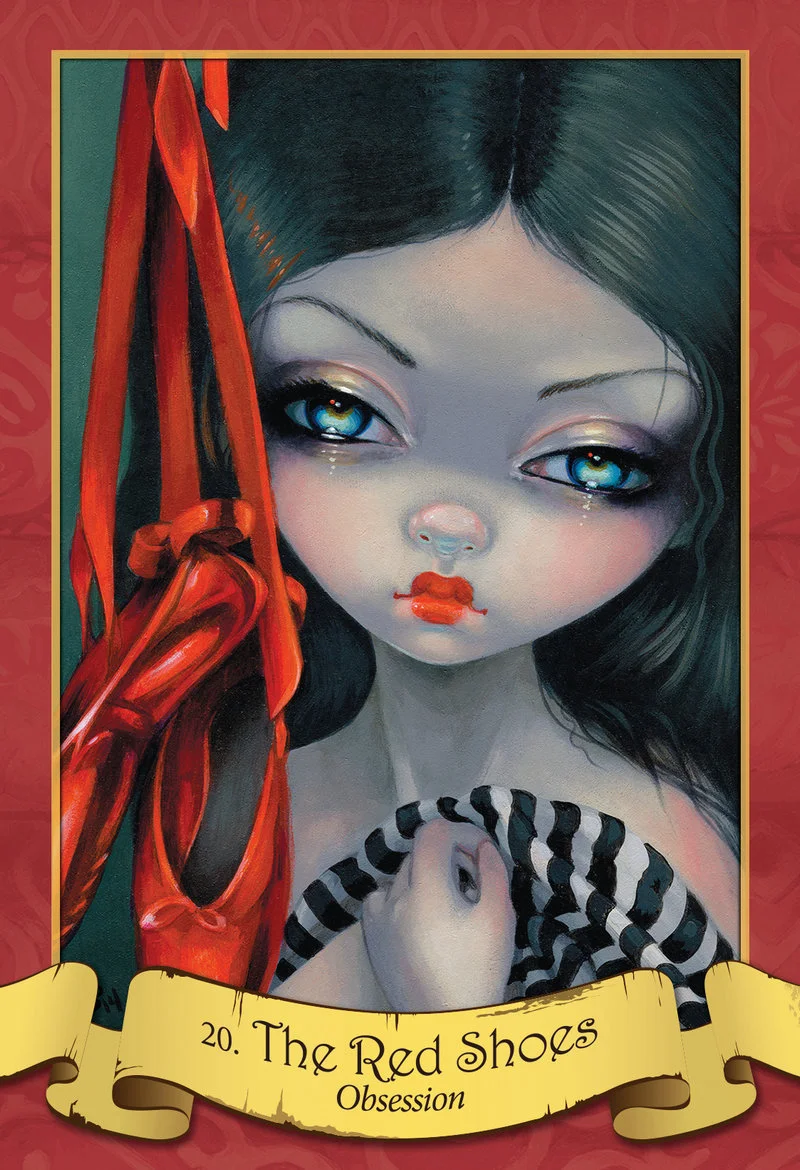
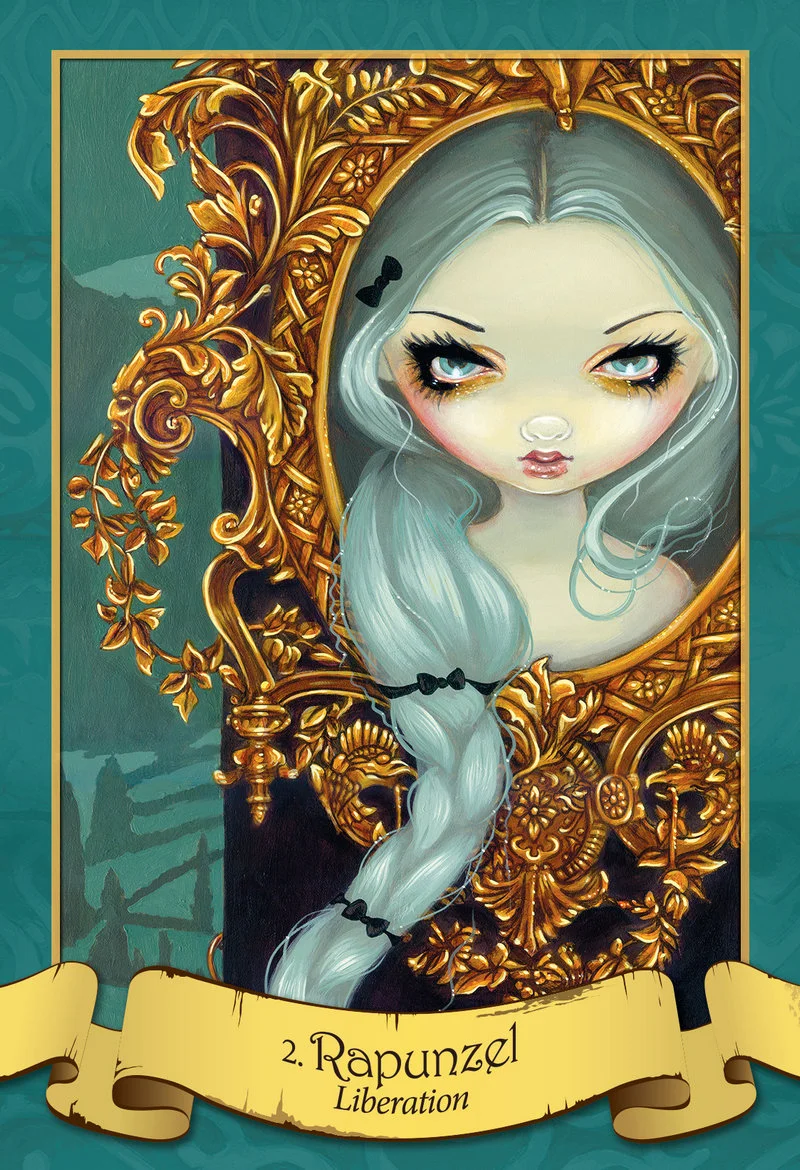
Faerytale Oracle – by Lucy CavendishFaerytale Oracle – Red Shoes, by Lucy Cavendish; artwork by Jasmine Becket-GriffithFaerytale Oracle – Rapunzel, by Lucy Cavendish; artwork by Jasmine Becket-Griffith
You have a beautiful deck, The Faerytale Oracle: An Enchanted Oracle of Initiation, Mystery and Destiny. Was your publisher Blue Angel immediately receptive? And what was the process of working with artist Jasmine Becket-Griffith on it?
Yes, they were very supportive! Jasmine had already created quite a body of work around fairy tales, and we collaborated on some new works for the deck. It was wonderful, such a joyful project for me, and I learned so much.
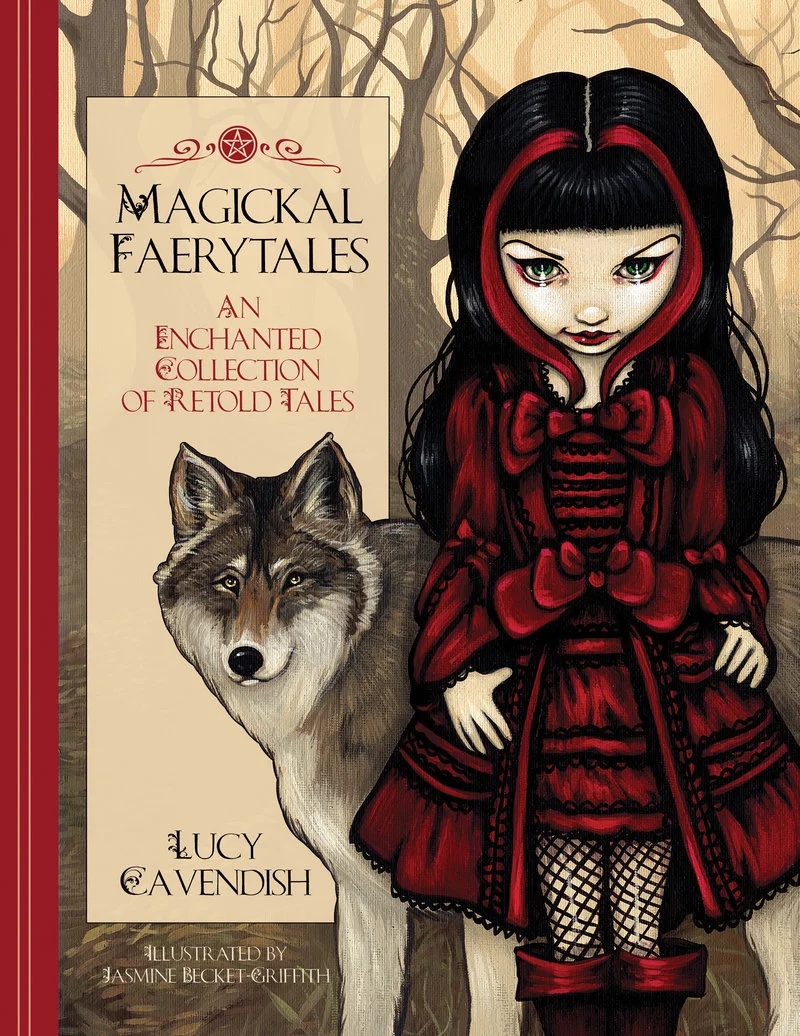
You also have a stunning book, Magickal Faerytales: An Enchanted Collection of Retold Tales. What was your intention with that?
I had ambitions of reclaiming, or emphasising, the connection to nature and the complexity of the relationship to nature within the stories. Also, there seemed a kind of pagan heart to the stories, although I am not sure I teased that out very effectively, but in some cases I feel satisfied that I did. I wanted to bring out the witchy nature of the stories and use magickal tools as part of them, and have the trees, waterfalls, sacred streams and animals have their magickal energies emphasised, too. I also wanted to write an original tale, which became The Ninth Wave, which closes the book.
How did you choose the stories you retold?
I had some that I wanted to do, like Little Red Riding Hood and Hansel and Gretel. I like the structure I gave Hansel and Gretel, but it really started with her voice in my head. The opening lines: The forest is said to be beautiful. “Oh, the forest,” people say, speaking from their safe homes and their warm fireplaces, with their round bellies full of food, their family nodding, only half listening. They’ve seen three trees and a flowerbed, and they think they know what nature is.”
Other stories include Rumpelstiltskin, which gave me a lovely opportunity to interweave the magick of knowing someone’s true name; The Goose Girl, with the brave fairy horse, Falada; Cinderella; Snow White and Rose Red; Rapunzel; and Snow White. In the version I wrote, the dwarves transformed into gnomes, her casket is crystalline, and I dared to change the nature of the awakening kiss, which had led to some outrage!
What makes the book extraordinary is that each story also has a beautiful, deeply moving “Discover the Magick of…” section, as long as the tale itself, which includes the history of and wisdom within each story, its pagan, witchy links, a spell, the meaning of some of the symbols, and more. How important was that to you, and did you enjoy the research?
This was suggested to me by Leela J Williams, who I have known for over twenty years now. She was the first editor assigned to the book, and I remember exactly where I was when we chatted for ages on the phone, and she suggested this approach. I thought these would make absolutely wonderful additions, and it gave me the scrumptious opportunity to work lots of smaller details into the stories, as well as lay them out clearly in the magickal section after each tale.
I nearly always enjoy research, the old-fashioned kind in particular. I love scribbling barely decipherable notes on paper as ah-ha moments come to me, or I learn some detail about the origin tale’s approximate location that feels like it just MUST be included. It also helped me decide on the kinds of trees, as an example, that I introduced into some tales. In one tale – I won’t say which one – they caused me agonies of indecision until I finally settled on two trees to represent two parents. Rapunzel is such a rich tale, too, and the diving deep helped me enormously and was immensely satisfying.
What was your reaction to this year’s conference theme?
I thought it was delicious!
Meet Lucy at the Australian Fairy Tale Conference in Melbourne this August. In the meantime, check out her enchanting books, including Magickal Faerytales, Spellbound and Witchy Magic, and oracle decks including The Faerytale Oracle, Into the Lonely Woods, The Solitary Witch and The Fairy Forest. Connect with her at instagram.com/lucycavendish.
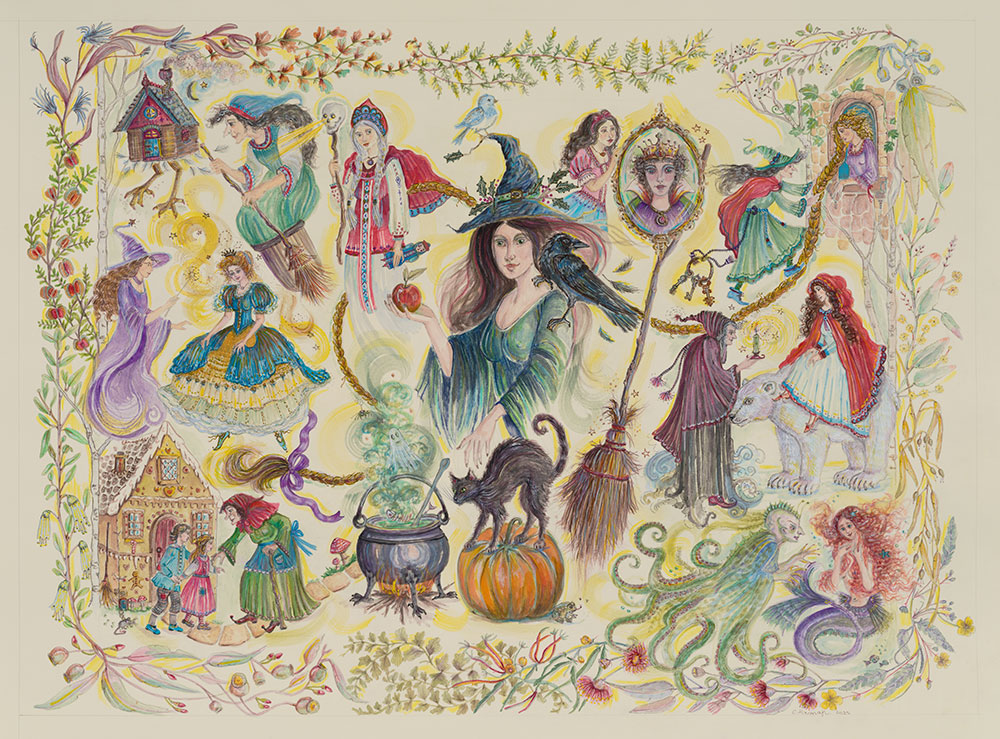
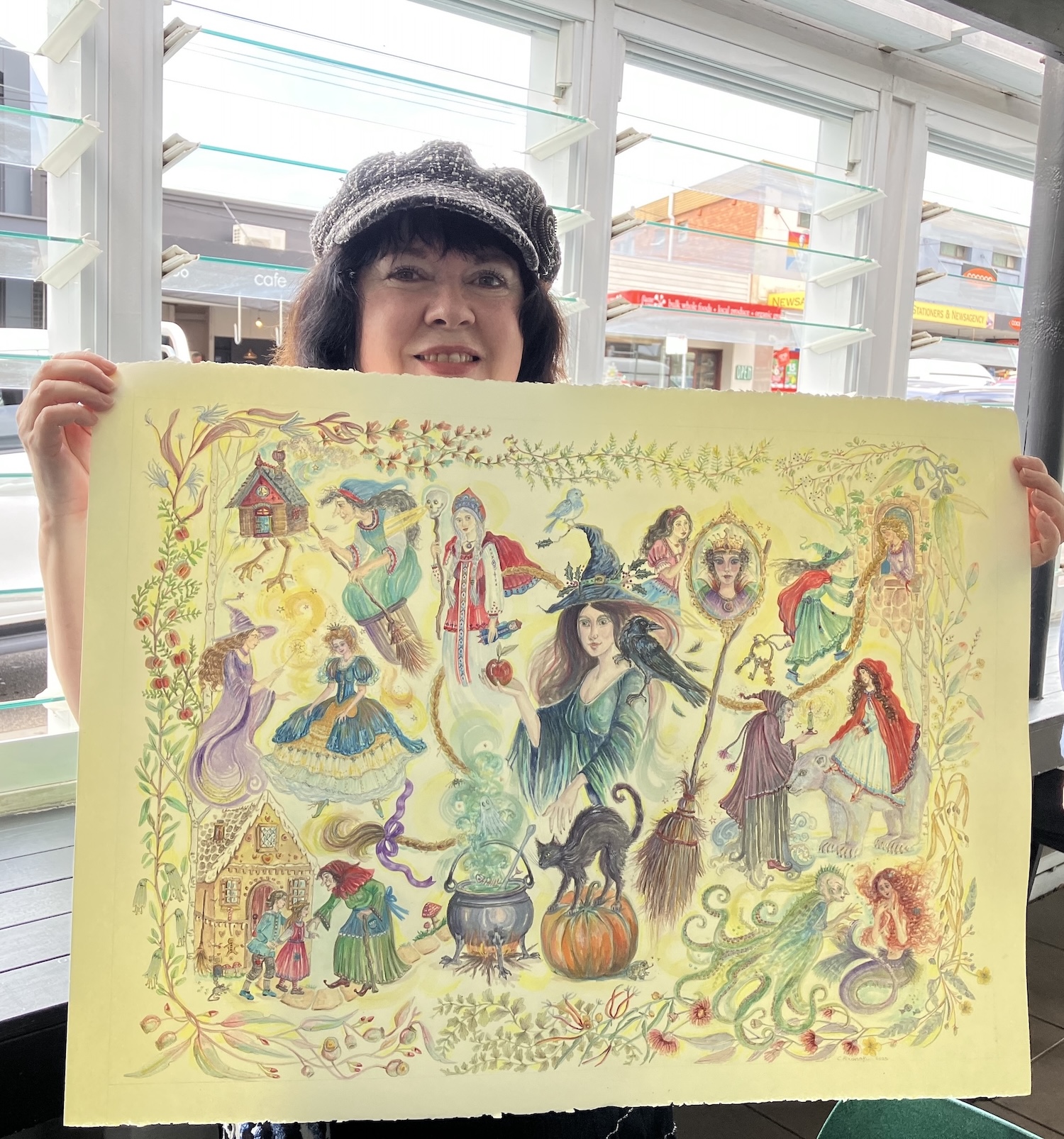
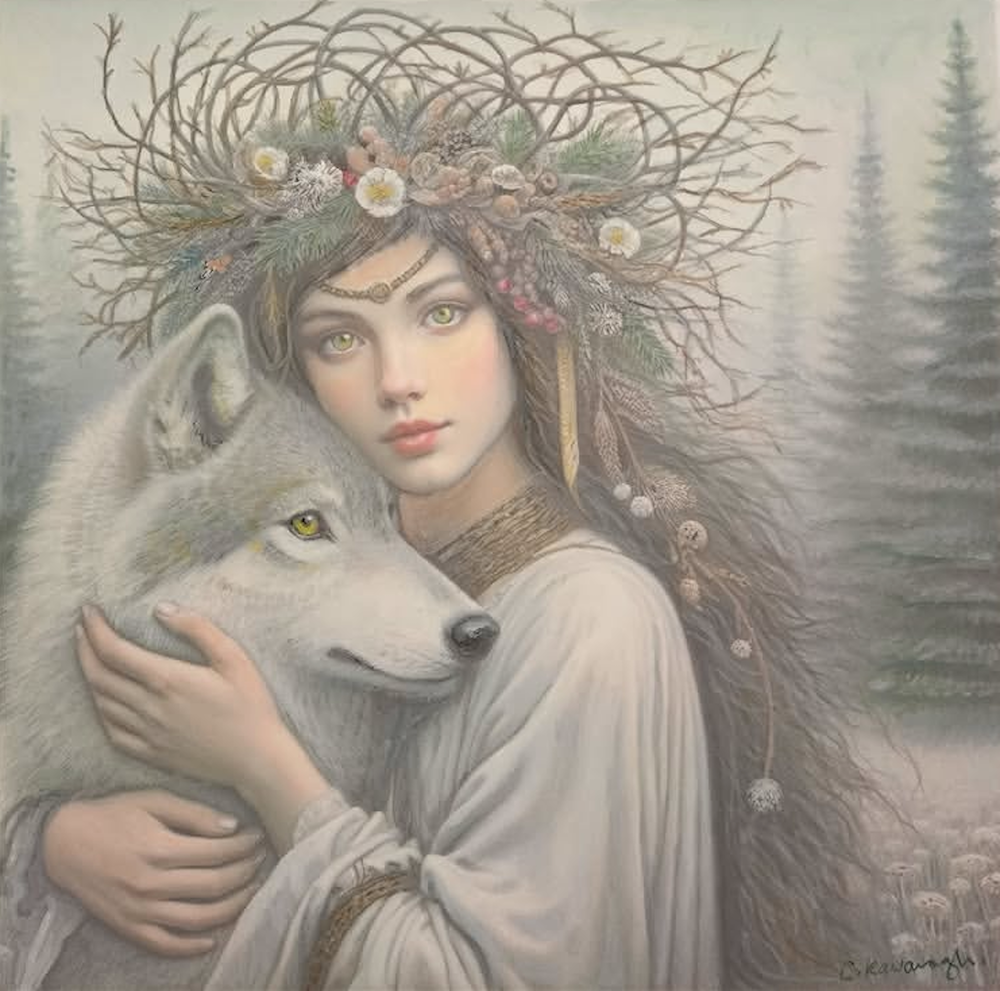
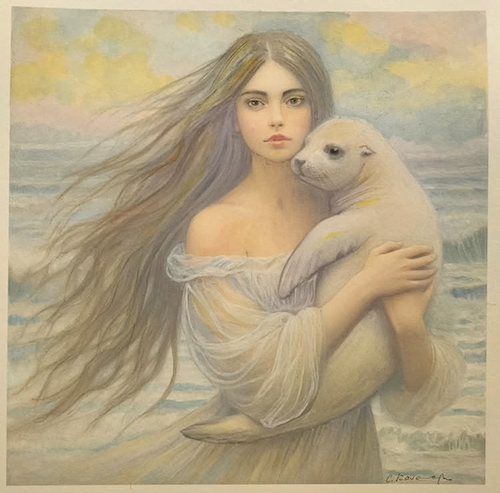
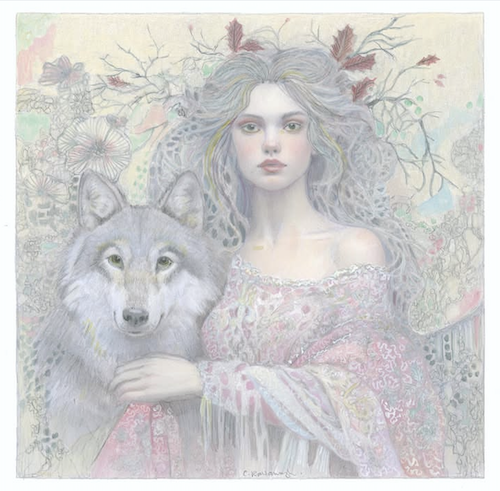
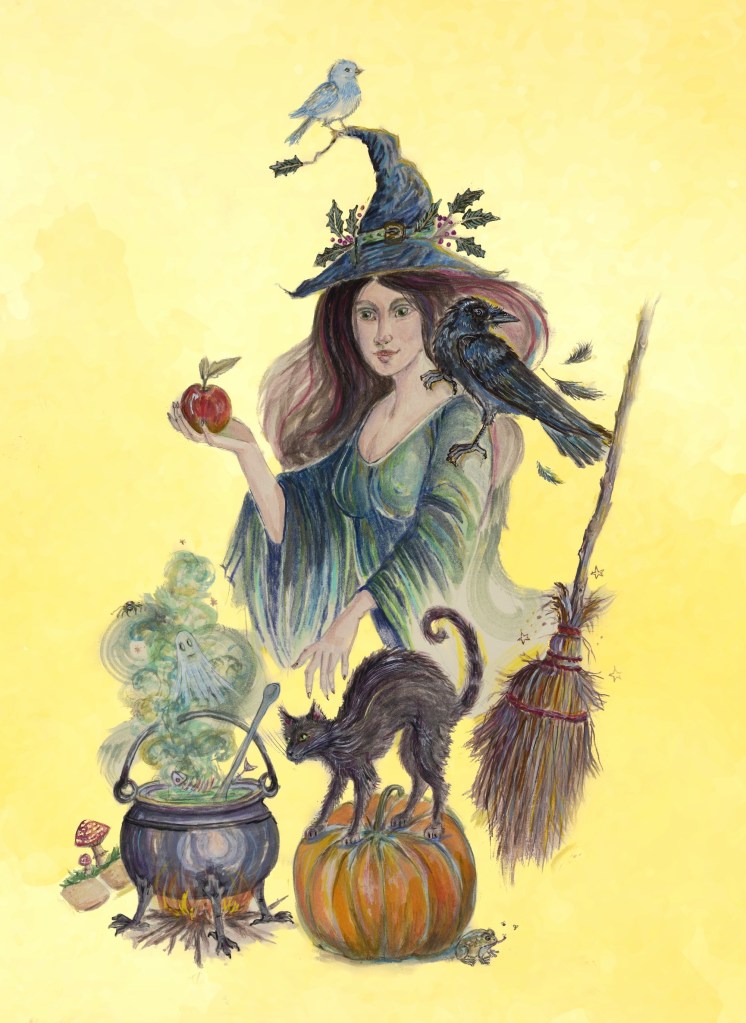
Witches in Fairy Tales as gloriously depicted by Cassandra Kavanagh, our 2026 conference artist
Come August 15-16, we’ll be Melbourne-bound for our 2026 conference, Witches in Fairy Tales: Wise Women or Evil Enchanters, as gloriously illustrated by Cassandra Kavanagh. Learn more in part 1 of our interview with this magical creator.
What drew you to fairy tales as a child?
I could read at age four, and the first books I was given were fairy tales. I believed every word. As I was a rather odd child with endless annoying questions, I was constantly sent down to the back of the garden to find the fey folk. I always took a fairy tale book with me to read out loud to the fairies. But the big golden event that was an everlasting shining moment in my life was being taken to an antique bookshop for my fifth birthday. The wonderful, enchanting old woman who owned this magical place showed me her favourite book. It was vast, heavy and old, stitched with gold thread, and the jewel-bright illustrations were protected by sheets of transparent rice paper, edged with gold. Fey-folk, fairies and old gods and goddesses wove their way through the pages like an enchantment. They felt familiar, as if in some other time and in some other life I had sat around a fire and heard these stories that seemed to still sing in my blood and had once warmed me over winter. The book beckoned like a doorway into another realm I belonged to.
What draws you to them now?
Fairy tales tell us who we are, how to be, and, more important still, how not to be. Fairy tales hold powerful reminders that resilience, true love, transformation and redemption are possible. They teach us that actions have consequences, often unforeseen. These time-upon-time tales that are passed down over hundreds, even thousands of years, hold ancient wisdom and warnings. They connect us to people in the past who had important things to tell us that still resonate now.
Do you have a favourite fairy tale?
Such a hard question. I love so many! However, I have always been drawn to Beauty and the Beast, and the numerous variations of the animal bridegroom in fairy tales. In particular, I adore the European stories featuring grey, white or silver wolves.
Friend Not FoeSelkie’s DaughterWolf Within the Woman
Do you have a least favourite?
I received Bluebeard for my seventh birthday and remain traumatised to this day. The story shook me to my bones! The illustrations were oddly beautiful, in stark contrast to their subject matter. The artwork depicting six murdered brides in long flowing gowns hung on meat hooks, while their blood pooled in swirls of pink and crimson beneath their pretty shoes, was truly horrifying. And as an incredibly curious child, I knew I would have disobeyed Bluebeard and opened the forbidden door with the mysterious key!
Tell us about the Illawarra Fairy Tale Ring*
Our Fairy Tale Ring meets on the last Thursday of every month. If I had more powerful magic, I would make it every week! It’s my favourite day of the month. Our amazing Ring Maidens, Pat Simmons and Helen McCosker, make it a truly magical experience. We pick a theme and an artist to study every month, and I am excited and enthralled every time. We all get along, and we are all a bit naughty in the nicest sense of the word! I have finally at long last found my tribe, and the experience is magical and enchanting. The Ring is like a magical box, with all the women-folk as the treasures.
Has being part of the Fairy Tale Ring inspired your art?
The members have been super supportive of my art, but the best is yet to come! I’m so inspired. Expect to see a lot more fairy-tale-inspired art from me! I am definitely going to paint more witches, and I have many that include fairy tale motifs and animals.
How long have you been painting?
I’ve been painting since the age of two, really as soon as I could hold a pencil or a paintbrush!
What inspired your early work?
I was inspired in equal measure by nature and by fairy tales, folklore, myths and legends. My birthday and Christmas presents were always books about these things. I was seriously bullied at school, so I would take my books and my sketch book and paints into the woods behind our house and sit by the stream. There I felt free to be me.
How has your art changed over time?
What has changed is my greater passion to put beauty and light back into a world that seems challenged by dark times. I have a new motivation to spread ancient and time-worn tales to a wider audience through my art – and I have become more passionate about reflecting paganism in my art, because the belief system honours the earth and her seasons while revering the natural environment and everything upon it. The smallest stone is as sacred as the forest.
What are you most looking forward to about this year’s Australian Fairy Tale Conference?
I’m most looking forward to the magic! Gathering with a community that shares and understands your passion is always so exciting, inspiring, heart-warming, soul-stirring and nurturing. The kinship with kindred spirits is a true blessing! I’m looking forward to indulging in my passion for all things fairy tale and witchy! I am also thrilled to extend my interest and learn from others, and of course, share my art.
* The AFTS has many Rings around Australia, including Adelaide, Brisbane, Perth, Sydney and Victoria, plus ‘Magic Mirror’ (our online Ring) that all members can attend. More details here, or E: austfairytales<at>gmail.com.
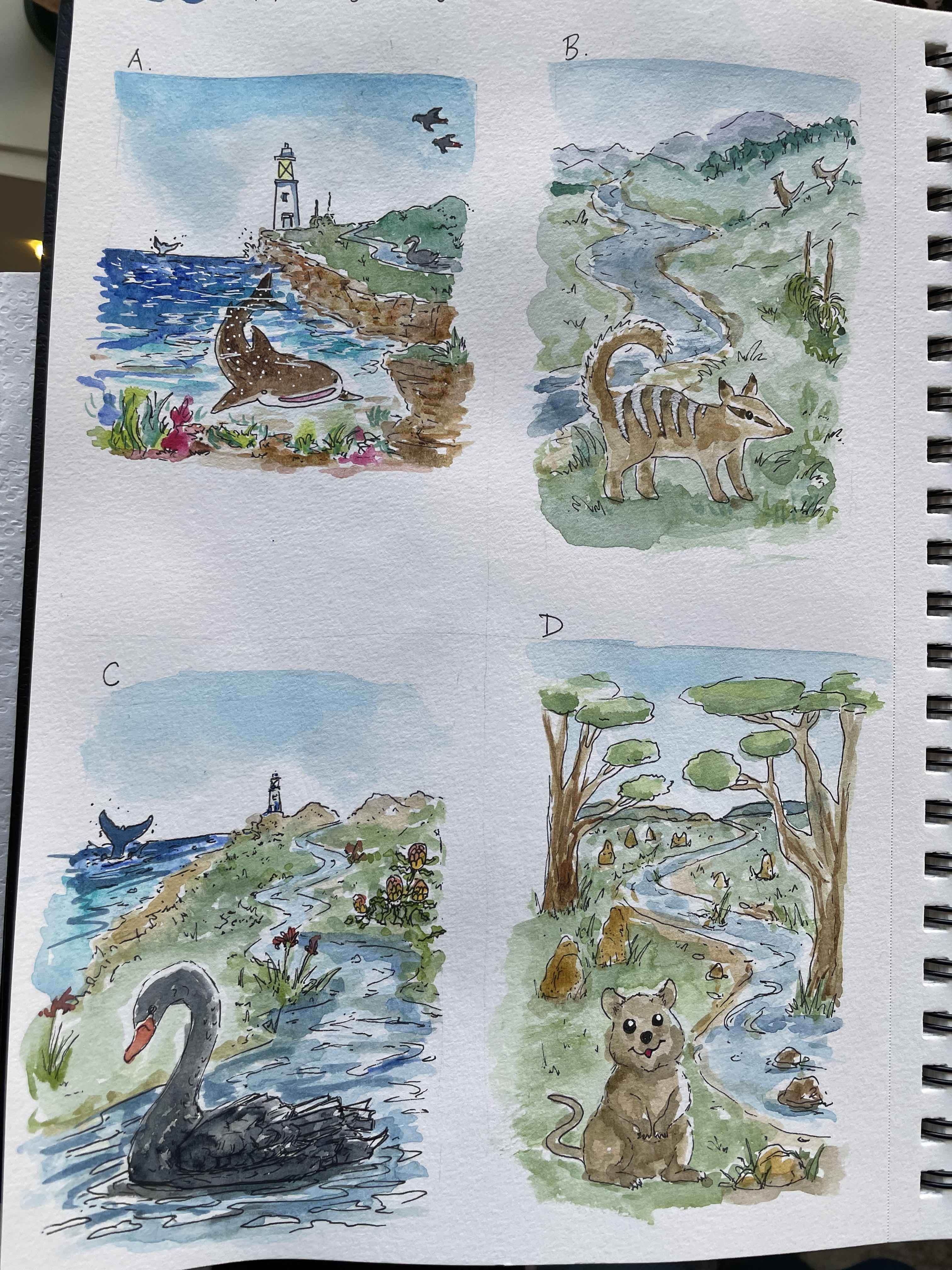
Around two years ago, I (Melanie Hobbs) volunteered to try designing a logo for the Perth Ring of the AFTS. Members suggested kangaroo paws, black swans, whale sharks or numbats as ideas. I thought it might be a fun project. I dabble in drawing and painting as a hobby, but trying to create a logo with just the right composition and appropriate pigmentation that fits the oval shape while looking cohesive alongside the other Ring logos turned out to be harder than I anticipated! Many months and sketches later, I still had nothing we could use.
When my good friend and artist Alex Myer visited Perth last year, I asked her if she would like to attempt a design for us. Alex came up with four fantastic draft designs (pictured below).
Alex Myer’s draft designs for Perth Ring logo
After discussing with fellow Perth Ring members Alyssa Curtayne, Debs Chaliha and Christine della Vedova, we felt the swan represented us best, being the animal that represents the state of Western Australia. There are several fairytales about swans too, so it felt right. We also loved the presence of wildflowers as Western Australia is known for its unique flora.
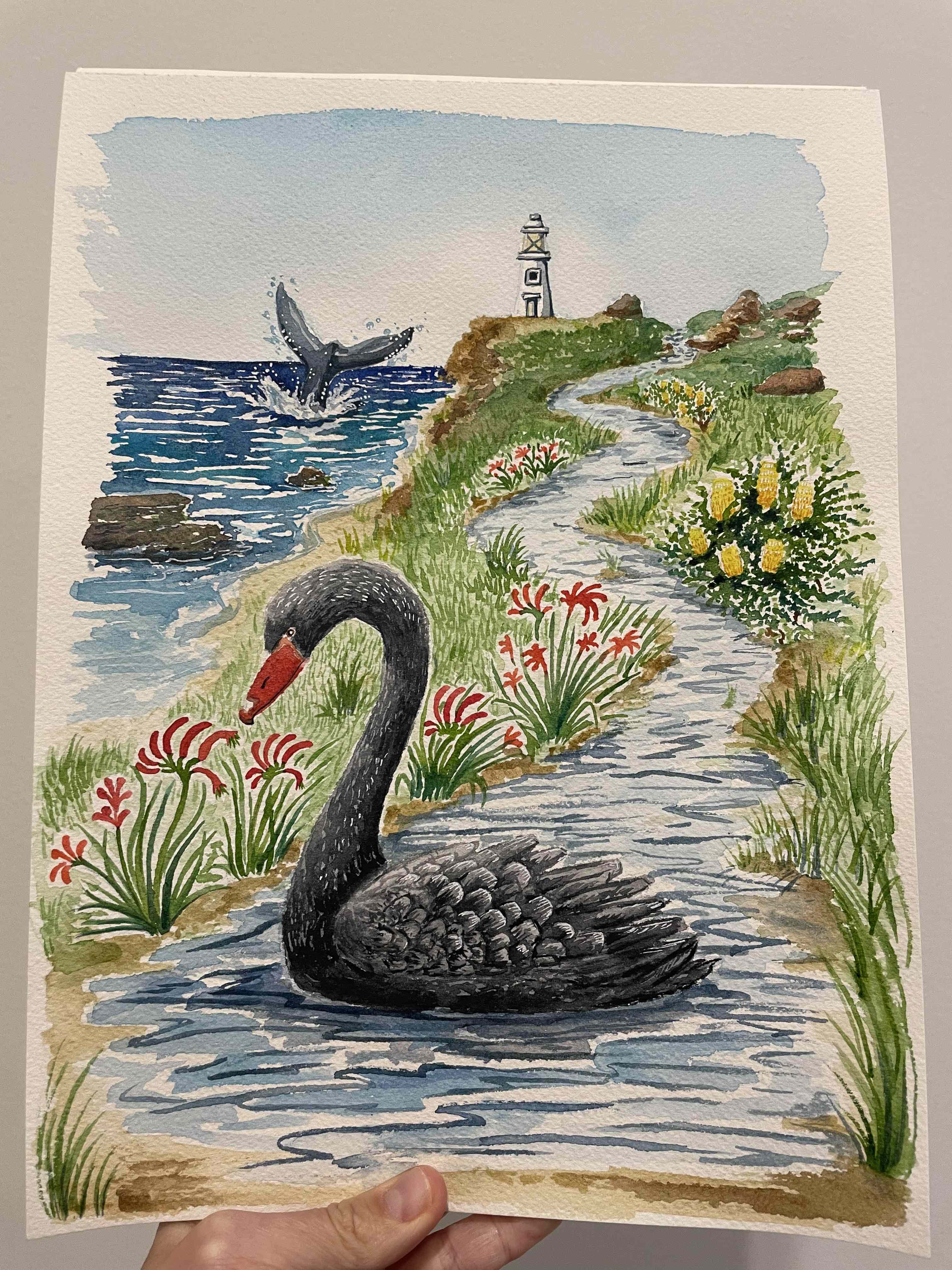
Alex got to work on the final design and when she sent it through we were blown away. The level of detail in each element and the layering is just exquisite. I had a chat with Alex about her art and the process she went through to create our logo pictured below. Isn’t it beautiful? Scroll on to read our conversation about her art and how the Perth Ring logo came into being!
Perth Ring Logo design by Alex Myers
Thanks for chatting with us, Alex. Tell us about your art or creative practice.
I am an avid urban sketcher, meaning I love to draw on location with the materials I have on hand to capture the essence of the place in real time, as it happens around me. The decisions around composition: to abstract, to remove, to emphasise, are the most difficult parts of sketching and I never know what the end product will look like. Once I leave a location, the artwork is deemed ‘finished’ and cannot be worked on later. This practice has helped me build a stronger way of ‘seeing’, building a visual vocabulary and ‘being’, that is, grounding myself in a space.
I’ve recently started experimenting with rendering abstract landscapes using mixed media and live portraits using watercolour and ink. Urban sketching has helped build up the visual reference points in my mind that I think helped me to become better at making creative decisions and to be able to work with fewer reference points.
What do you do outside of art?
My day job is to convince students that tests, marks, and grades are not as important as being a human being who can think creatively, collaborate, communicate and think critically. I am an educator. I teach grades 7-12 and I am currently teaching engineering in an independent school in New York City. I hope that through demystifying technology, that I can empower students to be curious about their world. AI and the robots are here! How do we do a better job at teaching kids the very few benefits and very large costs of engaging with these new technologies?
When I am not making art or planning lessons you will find me cooking with friends, relaxing in a yoga class, or stumbling my way through learning a new language (I’m studying French at the moment after levelling up to “intermediate” in Spanish) while planning my next international adventure.
When I first floated the idea of designing a logo for us, what came to mind? Tell us about your first ideas and drafts.
Mel, you floated the idea to me when I was visiting home in Perth and you showed me a sample from another ring to give me an idea of what might align with the other logos. I completed my high school and university education and have spent the majority of my education career in Perth. I drew upon memories of being a Bush Ranger in high school to get me started! As a student I worked on many conversation projects from water-testing and planting native flora around the lake near my high school to rehabilitating sand dunes in a marine park. I also coded my first website as a Bush Ranger and sketched native animal illustrations that were the very first graphics on it. These formative experiences also included trips to Rottnest/Wadjemup, bushwalking on the Bib, caving in Yanchep and visits to the Aquarium of Western Australia (AQWA). My first drafts really did come from memory and a few reference photos I’d taken myself and maybe a few from Google images.
After we decided on the swan, what was your process for turning the draft into the final logo? How long did it take?
I took my roughly A6 size draft and scaled it up to A4 on premium cold-pressed, Arches watercolour paper, my favourite surface to work on! I started with a rough pencil sketch then erased the darkest lines so that they were barely visible then I used a minimum of 4 watercolour layers, working wet on dry with a size 12 round brush. This means that I would wait until each layer was dry before going back into work on the next layer. I dug out the reference photos to zoom into to see the finer details and put the final touches such as the gloss on the swan’s wings in with a white Posca marker. This process took about 4-6 hours.
Wow, what a labour of love! Do you have a connection to the flora and fauna you’ve included in the logo?
I do! I was 12 years old when my family first moved to Perth and we used to visit a pair of black swans at Hyde Park after school everyday. I continued to live near there for almost 20 years and saw the family grow, leave and return, over and over again. It was a delight to see the fluffy, grey signets grow up every year. Now, my Perth home is near the hills, so I’ve swapped black swans for black cockatoos and my front garden is full of banksias, bottle brushes and kangaroo paws. I selected these to have a water-wise garden and because they bring me so much joy!
That is so special. Thank you for sharing your love of Western Australian flora and fauna with us. Do you have a favourite fairytale?
Despite how tragic the original version is, I love The Little Mermaid. Before I moved to Perth I grew up on small, coastal town where I could hear the sounds of the waves from the beach at night from our house. I played in rock pools, boogie-boarded and got dumped countless times by large waves. I spent many, many hours and days at the beach swimming with my family. Something that stuck with me was the day of a king tide, specially at low-tide. This is a semi-rare event where the gravitational pull on the tide is out so far that it reveals hidden reefs and exposes all the submerged sea critters to dry land! As a child, it felt like I was in the scene from “Under the Sea”, where all the sea creatures are dancing in the reef. We rented Disney’s The Little Mermaid VHS tape many times from the local video store and it still remains a favourite fairy tale for me.
The Little Mermaid is actually the next fairytale the Perth Ring will discuss! What is next for you? What are you hoping for your art or creative process in the future?
I just got accepted into a course called ‘Machine Language’ run by the School for Poetic Computation based in New York City. The course is focused on computation as a medium for critical and artistic expression. I am interested in learning about what it means to interact with machines at the hardware level and assembly language. The class will culminate in a collaborative project, so I’m excited to contribute to whatever that ends up looking like. The course is fully online and will run for 10 weeks starting at the end of January.
For my off-screen creative practice, I want to explore memoir through comics/graphic storytelling. I tend to represent my reality in a semi-realistic style, adhering to traditional composition techniques and playing it safe so I am hoping to branch out into a more whimsical and playful expression through learning how to distil and abstract reality. I am a huge fan of the Spanish urban sketcher, Maru Godas, and hope to be able to attend one of her gouache and mixed media workshops at the Urban Sketcher’s Symposium in Toulouse, France this July.
Thanks, Alex, for a stunning logo. You can find her on Instagram @alexmyer
Melbourne will host our 2026 Australian Fairy Tale Conference on August 15-16.
Theme: Witches in Fairy Tales: Wise Women or Evil Enchanters?
Venue: Arrow on Swanston, 488 Swanston Street, Carlton, VIC 3053
We’re excited to share this with you, as there’s so much to explore! Big thanks to conference artist, Cassandra Kavanagh.
Who’s your favourite fairytale witch? Are they portrayed as the stereotypical evil enchanter, like Maleficent from Sleeping Beauty or the Evil Queen in Snow White; or more nuanced like Baba Yaga, who is often portrayed as the guardian between life and death, or the magical helper rather than a straight-up villain; or is it one of those sweet helper witches who morphed into a fairy over time, like Cinderella’s fairy godmother?
Fairy tales are a slippery genre to define – the borders of definition are made of seaweed rather than coral, with different characteristics drifting in or out?
Instead of saying that for a story to be a fairy tale, it must have ‘x’ characteristics, it can be more useful to look at a range of characteristics and then measure any given story against them to determine to what extent it is a fairy tale.
We can start by broadly defining genres by saying that
MYTHS are cosmic, describing origins and creations of various kinds.
LEGENDS are local, starting with specific places and times, with plausible situations that might have happened, but are now expressed as larger-than-life victories, betrayals, and defeats.
FAIRY TALES are individual following the lives of character archetypes that can represent aspects of humanity. They work as a psychological codes telling eternal truths about human nature in dream imagery – truthful rather than realistic.
FOLK TALES can be distinguished from fairy tales, because the one essential of fairy tales is that they must contain something magical or supernatural, often involving some sort of transformation, whereas folk tales have started with a realistic anecdote or joke.
But when we get into specific stories, it can be trickier.
The Pied Piper of Hamelin happened in Hamelin, As there’s a statue there linking it to a historic event, it’s definitely a legend… except it has magical elements, thereby making it a fairy tale.
Little Red Riding Hood has no magic at all, so it’s simply a talking animal story… but the world acclaims it as a fairy tale because the transformation is psychological, not magical.
Bamboo Cutter’s Daughter has a magically-born child found by a childless couple. As she ends up being taken up to heaven with other Chinese gods, is it a myth or a fairy tale?
As the purpose of a fairy tale is to unite that which is divided to reach a satisfying (psychological) cohesion, fairy tales ‘should’ end with a Happy Ever After… but nearly all of Hans Christian Andersen’s and Oscar Wilde’s fairy tales have bittersweet endings.
If we assembled common fairy tale characteristics, there would be some that are more central:
Magical transformations
Archetypal characters
Third person narrative
Non-specific time
Vanquishing evil
Achieving power
Plus other characteristics that are less essential but very common:
Coming of age
Finding a home
Union of Masculine and Feminine in marriage
Non-human characters
Happy endings.
Any of these characteristics may or may not be present in any given story, like a Venn diagram, so when we examine any story against those criteria, we can say that it is a fairy tale to such a degree, or in such a way, but not in others.
From these ingredients, we can have an infinite number of variations or patterns within all the fairy tales in the world, as well as the many stories that sit in the liminal space between fairy tale and myth, or legend, or animal story.
Then again, lots of people just get it wrong. Alice in Wonderland is a fantasy novel. Robin Hood is a legend. Three Billy Goats Gruff is an animal story. Bloggers including them in lists of fairy tales doesn’t make them fairy tales.
It’s equally wrong to think that real fairy tales must be European. Yes, it’s a European art form, starting with Straparola and Basile in Italy, and being named and published by the French Salonnieres in the 1690s – but just because it started there doesn’t mean it ends there. After all, many of our families started in Europe too, but that doesn’t stop us from evolving into our own (multi-) culture. So we can look at stories in India or Peru or Zimbabwe and say to what extent they can be called fairy tales too.
And … we can continue to create new fairy tales – new magical tales of Once Upon A TIme and Happily Ever After – right here and now.
We can also continue to discuss and debate just what a fairy tale is. This is just to get the conversation rolling!
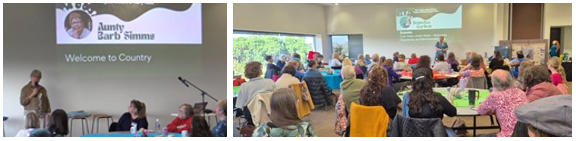
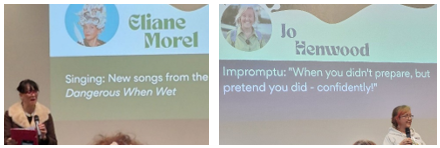
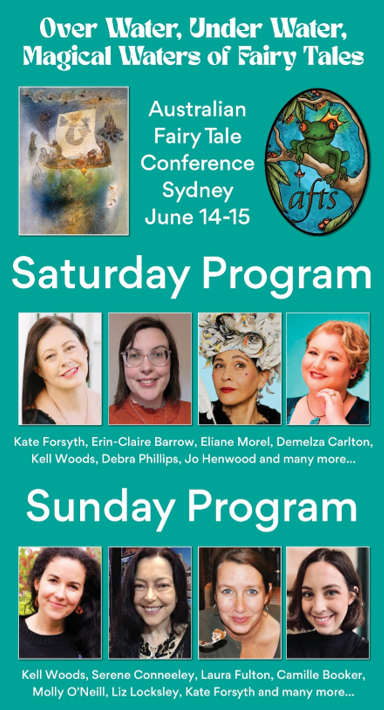
Only a month ago, seventy fairytalers – the largest number to attend any in-person AFTS conference so far – gathered together in Sydney for two glorious days of ideas, insights, inspiration, creativity, collaborations, and connections at Over Water, Under Water, Magical Waters of Fairy Tales.
From the time the whales breached in the ocean outside our window during the welcome to the last mesmerising words of Kate Forsyth’s storytelling, we delighted in a rich and varied program. This succeeded in stimulating fresh, exciting responses – as well as being lots of fun!
Prince Henry Centre at Little Bay was the perfect venue for our water-themed conference, where we were welcomed to country by Aunty Barb Simms, local Bidjigal woman and Aboriginal health worker.
Demelza Carlton’s keynote address took us over water on voyages across the seas to source fresh visions for old fairy tales, and discover new magical tales dwelling under our own Australian waters; an invigorating introduction to all that followed.
Supported by Joe Vandermeer’s technical expertise and unfailing support, we enjoyed talks that varied in perspective from geologist Molly O’Neill, artist Erin-Claire Barrow, Jungian psychologist Lisa Ritchie,
as well as panels that plumbed the depths (Camille Booker, Molly O’Neill, Kell Woods) or sailed wildly – and hilariously – off course (Barbie Robinson’s chairing of a panel that was not about Magic Tears.
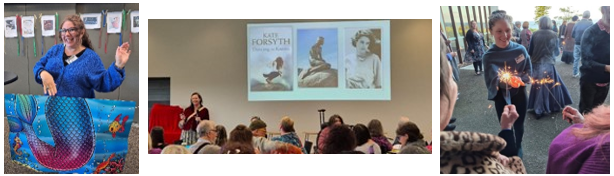
There were song performances (Eliane Morel), poetry (Alexandra McCallum), and many storytellers including Laura Fulton, Jill Webster, Jo Henwood, and Kate Forsyth.
We crested waves with a water dragon (Theresa Fuller), sailed across empires (Priti Modyiyer), and were cast low with Andersen’s unrequited love (Dr Kate Forsyth). We played with Dr Louise Phillips, blew bubbles and drew with sparklers while eating home-made AFTS birthday cake (baked by Liz Locksley), and made fairy jigsaws and took mermaid photos.
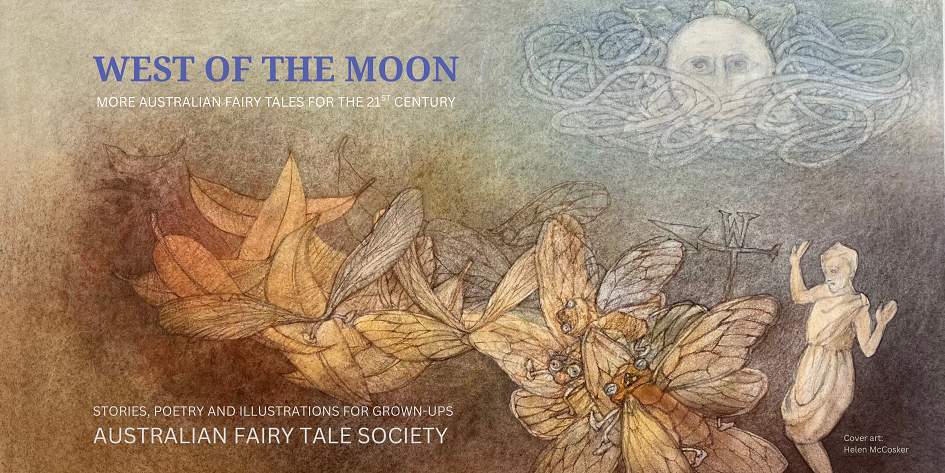
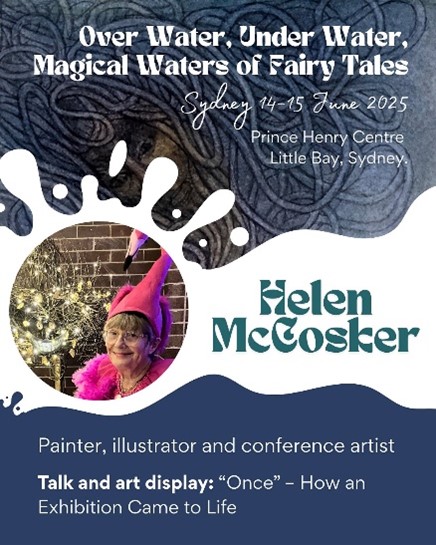
We dived into the possibilities of creating original Australian fairy tales for the new AFTS anthology West of the Moon, with Laura Fulton and Melanie Hill. The anthology’s cover art is by our own conference artist, Helen McCosker.
We seized the opportunities to buy books, art and merchandise in whimsically-decorated stalls (Granny Fi) and we ate. We ate a lot, thanks to Serene Conneeley and Liz Locksley for supplying the food, and Graham Harman for providing the plates. Most of all, we talked.
The conference gave us the chance to celebrate our community, including AFTS Award winner Spike Deane – a renowned glass artist, graphic designer, and website wizard.
The high attendance is a measure of success, because it was matched by genuine connection, and the authenticity of friendships consolidated by our time together – and those who continued the conversation at each after-conference dinner.
Huge congratulations and many thanks to all the talented presenters and hard-working behind-the-scenes people, and the AFTS members who helped with an early set-up and late pack-down, and to AFTS co-founder Reilly McCarron for sharing her photos with us.
And to You, who make hosting a conference worthwhile.
Serene Conneeley, Jo Henwood, Liz Locksley 2025 Conference Steering Committee
Fairy tale enthusiasts from across Australia and beyond will gather this weekend, June 14-15, in Sydney for our conference, Over Water, Under Water, Magical Waters of Fairy Tales.
For your interest and delight the full program has been revealed, and registrations are still welcome (quickly!) via our conference page. See you at Prince Henry Bay!
The place where we will meet for our Sydney conference – our coming together – is Bidjigal land, water, and sky. Current evidence is that Aboriginal people have been living around Sydney Harbour for about 20,000 years, though the population was thin and sporadic up until about 5,000 years ago.
One of the two oldest sites around current Sydney is a hearth from about 7,800 years before present at the old Prince Henry Hospital site. We truly will be standing on ancient land as many generations have done before us.
We are honoured and grateful that Aunty Barbara Simms-Keeley will Welcome us to her Country.
Aunty Barbara, a Bidjigal, Gweagal and Wandi Wandi elder, who was taken away from her family when she was just eight years old, grew up on a nearby Mission. She knows this place deeply and can tell stories from the mid-20th century about fishing and swimming around here, and the people and places that she remembers. Here’s one she recorded for the NSW National Parks and Wildlife Service.
Aunty Barbara protects the living too as an experienced Aged Care Co-ordinator, and as an Aboriginal health worker who has worked tirelessly in raising community awareness around cancer. She also nurtures and educates all the community, from whatever cultural background, to listen, to understand and to respect.
We are very grateful to her and to the Bidjigal people for making us welcome.
The stunning artwork for this year’s conference, Over Water, Under Water, Magical Waters of Fairy Tales, is worth diving deep into to find all the stories and characters that are hidden under water.
If you would like to own this art yourself, you can buy any version of merchandise you choose through the AFTS Redbubble store.
This remarkable painting was created by our own Helen McCosker, who contributes so much to the Illawarra Fairy Tale Ring, including the creation of their logo.
Helen is a children’s author and illustrator from Thirroul, a seaside village south of Sydney. Helen’s picture book, The Night Fish – another watery theme! – was published in 2006 by The Five Mile Press.
As a keen woodworker, she is currently working on a collection of wooden ‘assemblages’ inspired by her love of fairy tales.
Helen continues to share not only her art and depth of knowledge, but the generosity of spirit that inspires other member artists to find new ways of interpreting fairy tales – which is what the Society is all about. You can meet her from June 14-15 at the conference, where she will deliver, Once: How an Exhibition Came to Life.







 Australian Fairy Tale Society