Around two years ago, I (Melanie Hobbs) volunteered to try designing a logo for the Perth Ring of the AFTS. Members suggested kangaroo paws, black swans, whale sharks or numbats as ideas. I thought it might be a fun project. I dabble in drawing and painting as a hobby, but trying to create a logo with just the right composition and appropriate pigmentation that fits the oval shape while looking cohesive alongside the other Ring logos turned out to be harder than I anticipated! Many months and sketches later, I still had nothing we could use.
When my good friend and artist Alex Myer visited Perth last year, I asked her if she would like to attempt a design for us. Alex came up with four fantastic draft designs (pictured below).
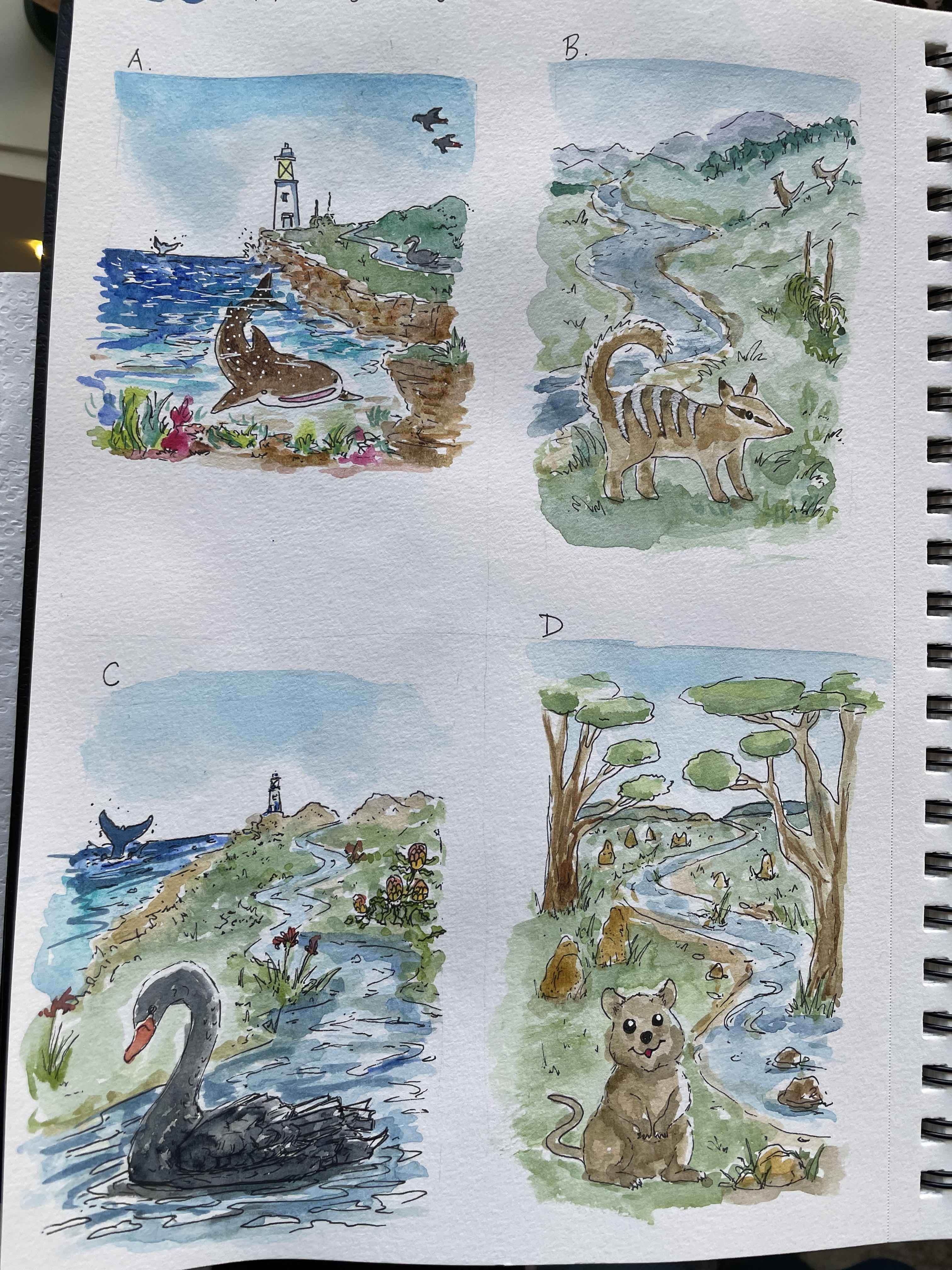
After discussing with fellow Perth Ring members Alyssa Curtayne, Debs Chaliha and Christine della Vedova, we felt the swan represented us best, being the animal that represents the state of Western Australia. There are several fairytales about swans too, so it felt right. We also loved the presence of wildflowers as Western Australia is known for its unique flora.
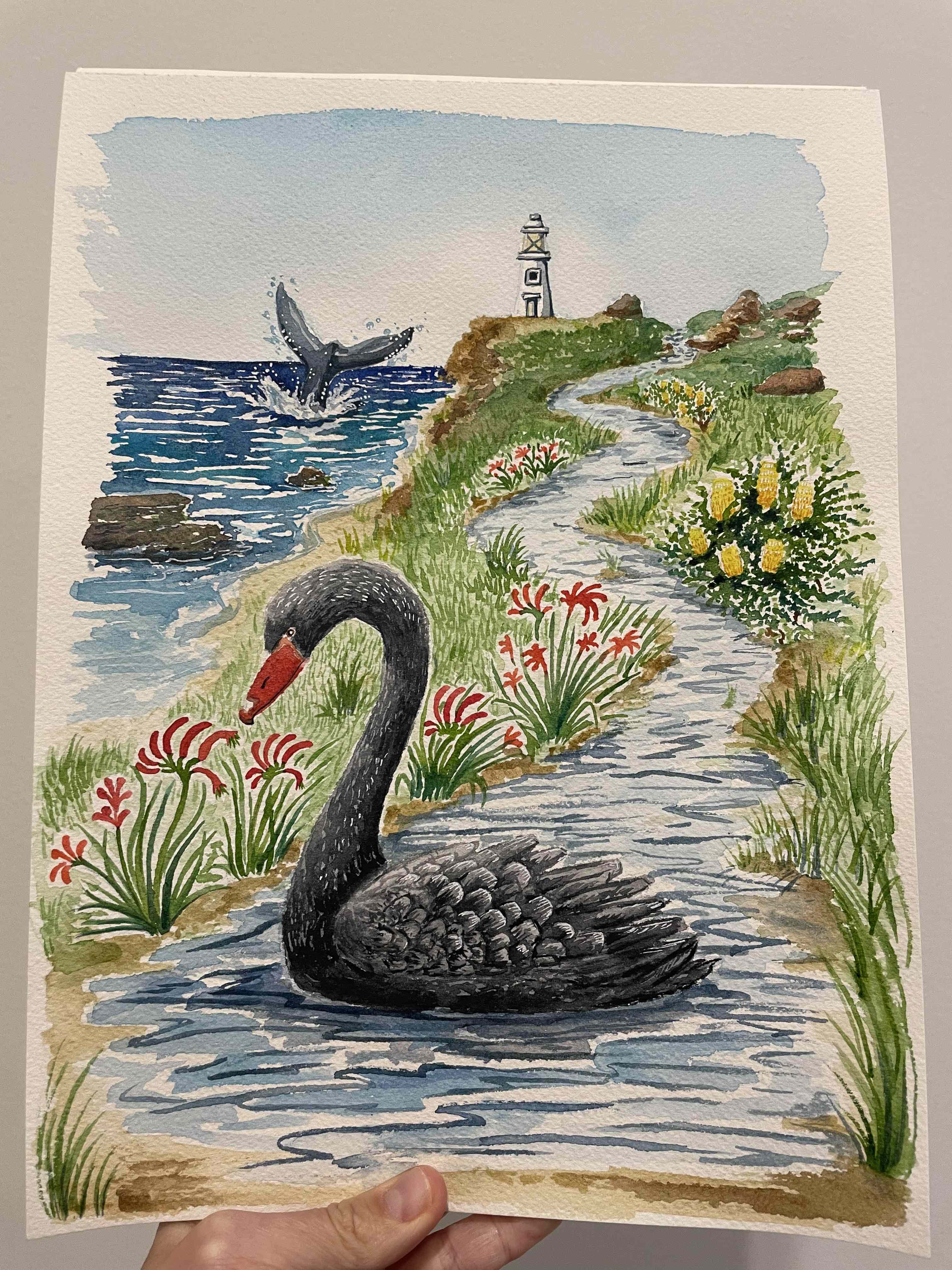
Alex got to work on the final design and when she sent it through we were blown away. The level of detail in each element and the layering is just exquisite. I had a chat with Alex about her art and the process she went through to create our logo pictured below. Isn’t it beautiful? Scroll on to read our conversation about her art and how the Perth Ring logo came into being!
Thanks for chatting with us, Alex. Tell us about your art or creative practice.
I am an avid urban sketcher, meaning I love to draw on location with the materials I have on hand to capture the essence of the place in real time, as it happens around me. The decisions around composition: to abstract, to remove, to emphasise, are the most difficult parts of sketching and I never know what the end product will look like. Once I leave a location, the artwork is deemed ‘finished’ and cannot be worked on later. This practice has helped me build a stronger way of ‘seeing’, building a visual vocabulary and ‘being’, that is, grounding myself in a space.
I’ve recently started experimenting with rendering abstract landscapes using mixed media and live portraits using watercolour and ink. Urban sketching has helped build up the visual reference points in my mind that I think helped me to become better at making creative decisions and to be able to work with fewer reference points.
What do you do outside of art?
My day job is to convince students that tests, marks, and grades are not as important as being a human being who can think creatively, collaborate, communicate and think critically. I am an educator. I teach grades 7-12 and I am currently teaching engineering in an independent school in New York City. I hope that through demystifying technology, that I can empower students to be curious about their world. AI and the robots are here! How do we do a better job at teaching kids the very few benefits and very large costs of engaging with these new technologies?
When I am not making art or planning lessons you will find me cooking with friends, relaxing in a yoga class, or stumbling my way through learning a new language (I’m studying French at the moment after levelling up to “intermediate” in Spanish) while planning my next international adventure.
When I first floated the idea of designing a logo for us, what came to mind? Tell us about your first ideas and drafts.
Mel, you floated the idea to me when I was visiting home in Perth and you showed me a sample from another ring to give me an idea of what might align with the other logos. I completed my high school and university education and have spent the majority of my education career in Perth. I drew upon memories of being a Bush Ranger in high school to get me started! As a student I worked on many conversation projects from water-testing and planting native flora around the lake near my high school to rehabilitating sand dunes in a marine park. I also coded my first website as a Bush Ranger and sketched native animal illustrations that were the very first graphics on it. These formative experiences also included trips to Rottnest/Wadjemup, bushwalking on the Bib, caving in Yanchep and visits to the Aquarium of Western Australia (AQWA). My first drafts really did come from memory and a few reference photos I’d taken myself and maybe a few from Google images.
After we decided on the swan, what was your process for turning the draft into the final logo? How long did it take?
I took my roughly A6 size draft and scaled it up to A4 on premium cold-pressed, Arches watercolour paper, my favourite surface to work on! I started with a rough pencil sketch then erased the darkest lines so that they were barely visible then I used a minimum of 4 watercolour layers, working wet on dry with a size 12 round brush. This means that I would wait until each layer was dry before going back into work on the next layer. I dug out the reference photos to zoom into to see the finer details and put the final touches such as the gloss on the swan’s wings in with a white Posca marker. This process took about 4-6 hours.
Wow, what a labour of love! Do you have a connection to the flora and fauna you’ve included in the logo?
I do! I was 12 years old when my family first moved to Perth and we used to visit a pair of black swans at Hyde Park after school everyday. I continued to live near there for almost 20 years and saw the family grow, leave and return, over and over again. It was a delight to see the fluffy, grey signets grow up every year. Now, my Perth home is near the hills, so I’ve swapped black swans for black cockatoos and my front garden is full of banksias, bottle brushes and kangaroo paws. I selected these to have a water-wise garden and because they bring me so much joy!
That is so special. Thank you for sharing your love of Western Australian flora and fauna with us. Do you have a favourite fairytale?
Despite how tragic the original version is, I love The Little Mermaid. Before I moved to Perth I grew up on small, coastal town where I could hear the sounds of the waves from the beach at night from our house. I played in rock pools, boogie-boarded and got dumped countless times by large waves. I spent many, many hours and days at the beach swimming with my family. Something that stuck with me was the day of a king tide, specially at low-tide. This is a semi-rare event where the gravitational pull on the tide is out so far that it reveals hidden reefs and exposes all the submerged sea critters to dry land! As a child, it felt like I was in the scene from “Under the Sea”, where all the sea creatures are dancing in the reef. We rented Disney’s The Little Mermaid VHS tape many times from the local video store and it still remains a favourite fairy tale for me.
The Little Mermaid is actually the next fairytale the Perth Ring will discuss! What is next for you? What are you hoping for your art or creative process in the future?
I just got accepted into a course called ‘Machine Language’ run by the School for Poetic Computation based in New York City. The course is focused on computation as a medium for critical and artistic expression. I am interested in learning about what it means to interact with machines at the hardware level and assembly language. The class will culminate in a collaborative project, so I’m excited to contribute to whatever that ends up looking like. The course is fully online and will run for 10 weeks starting at the end of January.
For my off-screen creative practice, I want to explore memoir through comics/graphic storytelling. I tend to represent my reality in a semi-realistic style, adhering to traditional composition techniques and playing it safe so I am hoping to branch out into a more whimsical and playful expression through learning how to distil and abstract reality. I am a huge fan of the Spanish urban sketcher, Maru Godas, and hope to be able to attend one of her gouache and mixed media workshops at the Urban Sketcher’s Symposium in Toulouse, France this July.
Thanks, Alex, for a stunning logo.
You can find her on Instagram @alexmyer
 Australian Fairy Tale Society